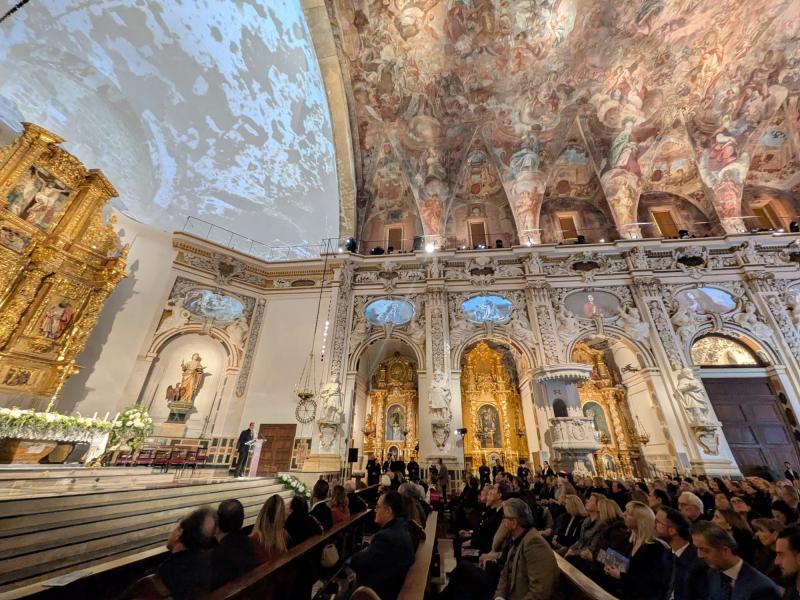
He also emphasized that “scientific rigor and artistic sensitivity were non-negotiable throughout the process.” A key leader of the interior restoration has been Full Professor Pilar Roig, faculty member of the Department of Conservation and Restoration of Cultural Heritage at UPV and researcher at the Institute for Heritage Restoration. “Her scientific direction has made it possible to reinstate the image of an ensemble destroyed by fire, combining historical photography and preserved original fragments with sustainable, innovative conservation methodologies,” the rector noted.
The architectural rehabilitation was led by architect Carlos Campos, whose work addressed structural pathologies, restored façades to their original character, and included the Communion Chapel and bell tower, along with renewed lighting and valorisation systems. Capilla recognized his contribution as “a restoration that has recovered the material truth of the building and secured its future.”
To complete the project, the Fundación Hortensia Herrero promoted an immersive audiovisual projection experience using video mapping, light, and sound to offer a symbolic interpretation of the Baroque space. “Technology does not compete with art—it amplifies it. This initiative opens the temple to new generations,” the rector concluded.
The cross-disciplinary UPV collaboration involved institutes such as the iTEAM, the architecture and industrial engineering schools, and researchers from the Faculty of Fine Arts. Nearly 90 UPV experts contributed more than 80,000 combined work hours. “This confirms our university’s social and scientific commitment to preserving Valencian heritage,” said Capilla.