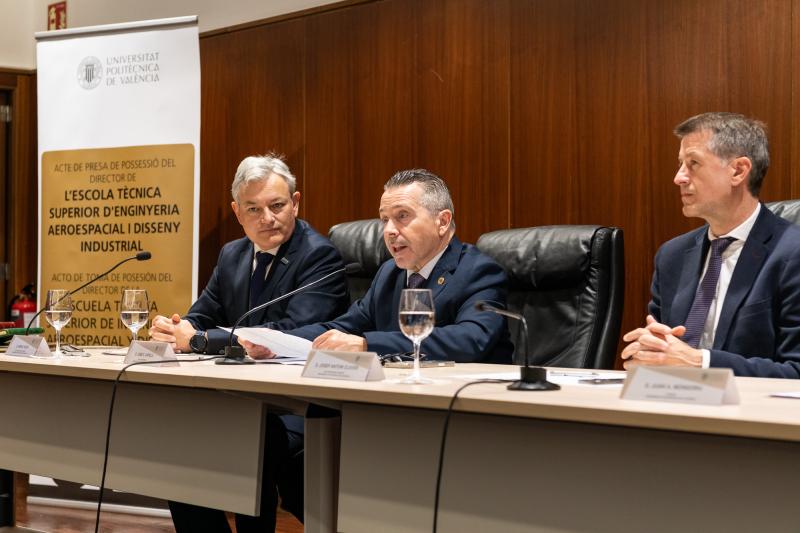
The Rector has underlined that ETSIADI is not merely an academic institution, but “a space where the future is anticipated,” and has emphasised that the degrees it offers — aerospace engineering, industrial design, electrical engineering, industrial electronics and automation, and mechanical engineering — are strategic for society and the productive system. In this regard, he has affirmed that “here, students not only acquire knowledge, but also develop talent, leadership and a project-driven mindset through initiatives such as experimental rocketry, unmanned aircraft and electric vehicles.”
Capilla has also highlighted the School’s international outlook and its strong links with the technological industry. “Engineering is global by nature, and this School has understood that earlier than many,” he has noted, stressing its participation in European programmes, its presence in international academic networks and its capacity to attract global talent. He has further pointed out that “the Master’s Degree in Electric Mobility and the Master’s Degree in Unmanned Aircraft Systems position the School at the forefront of high value-added emerging sectors.”
The Rector has also addressed the current context facing higher education, marked by global competition, regulatory changes and a decline in scientific and technological vocations. In this scenario, he has defended the need to train engineers capable of integrating artificial intelligence and new technologies into their professional practice. “It is not about competing against artificial intelligence, but about amplifying talent with it,” he has stated.
Capilla has affirmed that today’s challenges open up major opportunities in areas such as the energy transition, the space economy, sustainable mobility, advanced automation and sustainable industrial design. In this sense, he has recalled that the mission of the School and of the UPV is “not merely to interpret reality, but to build new possibilities.”
Finally, the Rector has reiterated his commitment to the new leadership team and has assured that “we will work together to strengthen the School, address its needs and maintain its academic excellence and international projection.” Capilla has concluded by wishing Pedro Yuste every success in his six-year term, convinced that ETSIADI will continue to be “one of the UPV’s major technological drivers and a benchmark in the training of engineers capable of designing, building and piloting the future.”