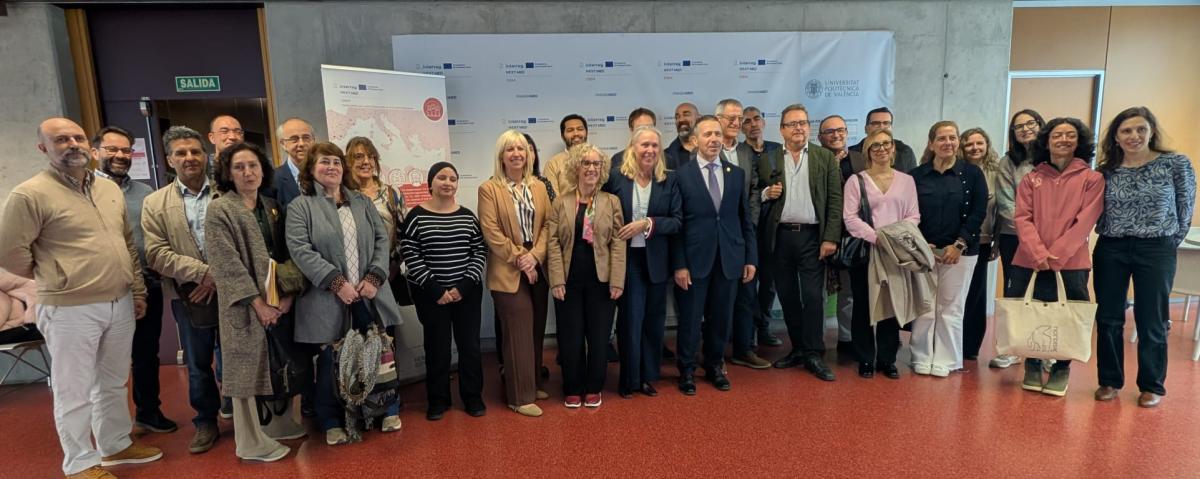
The Universitat Politècnica de València is participating in the European project Developing Inclusive Education in the Mediterranean (DIEM), an initiative with a total budget of €2.81 million —89% of which has been funded by the European Union through Interreg NEXT MED— and which over three years will foster inclusive education linked to cultural heritage as a pathway to improving employability in the Mediterranean region.
The Rector of UPV, José Capilla, has highlighted that DIEM “fully represents the kind of university we aspire to be: international, committed to heritage, and capable of generating opportunities.”
The project, led by Sapienza Università di Roma, has brought together academic institutions and entities from Italy, Jordan, Tunisia, Egypt and Palestine, consolidating a cooperation network focused on training and social development through cultural heritage.
Within the consortium, UPV has taken on a key role through its University Institute for Heritage Restoration (IRP), the only partner specialized in cultural heritage conservation. The UPV team has been responsible for designing the training system, educational content and overall strategy.
The UPV contribution has been coordinated by Francisco Juan Vidal and has included Santiago Lillo Giner, Ignasi Gironés Sarrió, Mónica Val Fiel, Santiago Tormo Esteve, Xavier Mas Barberá, Salvador Muñoz Viñas and María Victoria Vivancos Ramón.
Capilla has emphasized the IRP’s international track record and has recalled that collaboration with Jordan in the field of heritage has already exceeded 25 years, consolidating a stable, long-term academic partnership. DIEM is a train-the-trainers project aimed at equipping specialists in conservation, management and dissemination of cultural heritage, with particular attention to vulnerable groups facing barriers to education and employment.
The initiative has leveraged technological infrastructures to overcome geographical and social limitations and to reduce the gap between the rich Mediterranean cultural heritage and the opportunities it can generate in terms of development and employability.
“Training professionals who currently live in complex contexts is an investment in the future and in the protection of highly valuable cultural heritage,” the Rector has stated.
In UPV’s case, the project has taken as a reference the Rock Art of the Mediterranean Basin on the Iberian Peninsula, declared a World Heritage Site by UNESCO. In the Valencian Community, there are nearly 600 rock art sites, 351 of which have been recognized by UNESCO, mainly located in els Ports and Alt Maestrat, the Caroig Massif, and the Marina valleys and Alcoy area.
Capilla has congratulated the UPV team and the international partners and has affirmed that DIEM “has been conceived with a clear vocation for continuity and for generating new Mediterranean alliances.”