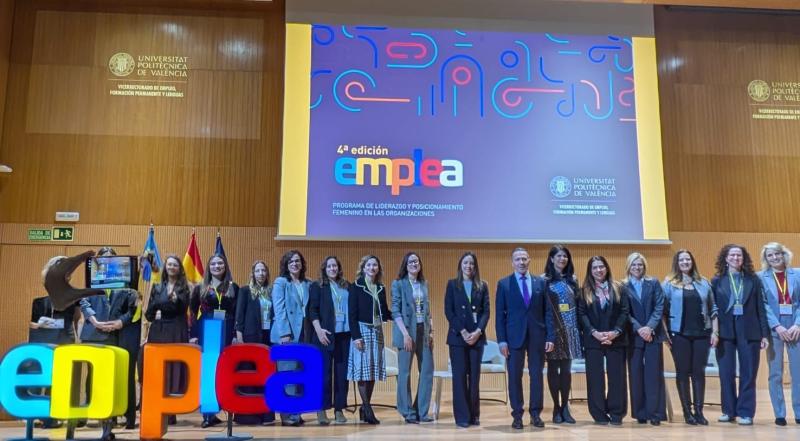
During the ceremony, José Capilla highlighted the programme’s results and stated that “70% of the participants in the previous edition are now working or undertaking internships with companies involved in the programme,” a figure which, in his words, “demonstrates that this programme has a real impact.”
The Rector stressed that Emplea “is not an isolated initiative, but part of a structural strategy” within the university’s comprehensive employability policy, based on data, partnerships and quality standards. In this regard, he recalled that over the past year the UPV has managed 10,790 internships in companies and institutions, involving 2,532 organisations and generating more than €15 million in financial support.
He also noted that more than 215 companies participated in the 2025 Employment Forum, attracting over 6,000 visitors and generating 44,640 CV submissions. Following the forum, 125 companies signed 1,240 internship agreements with 823 students. “This is not a statement of intent; it is an ecosystem,” he stated.
Capilla also emphasised the 110 active chairs in 2025, with funding close to €7 million, 65% of which have been running for more than three years, reflecting — he pointed out — “business loyalty and trust.” He further recalled that the Integrated Employment Service has obtained the Employability and Entrepreneurship Seal — becoming the first Spanish university to do so — and has held ISO 9001 certification for 24 years.
Regarding the programme itself, he explained that Emplea combines executive training delivered by UPV and IESE Business School faculty, mentoring by twelve senior female executives and strategic challenges linked to sectors such as energy, mobility, banking, industry, health and artificial intelligence. “We are not talking about simulated case studies; we are talking about Europe’s industrial and technological future,” he underlined.
The Rector argued that “21st-century employability requires entrepreneurial leadership” and stressed that Europe needs more STEAM profiles and, above all, more women leading in areas such as artificial intelligence, the energy transition and sustainable mobility. In this regard, he encouraged students to take an active role in transforming their sectors: “Do not aspire merely to occupy spaces. Aspire to create them.”