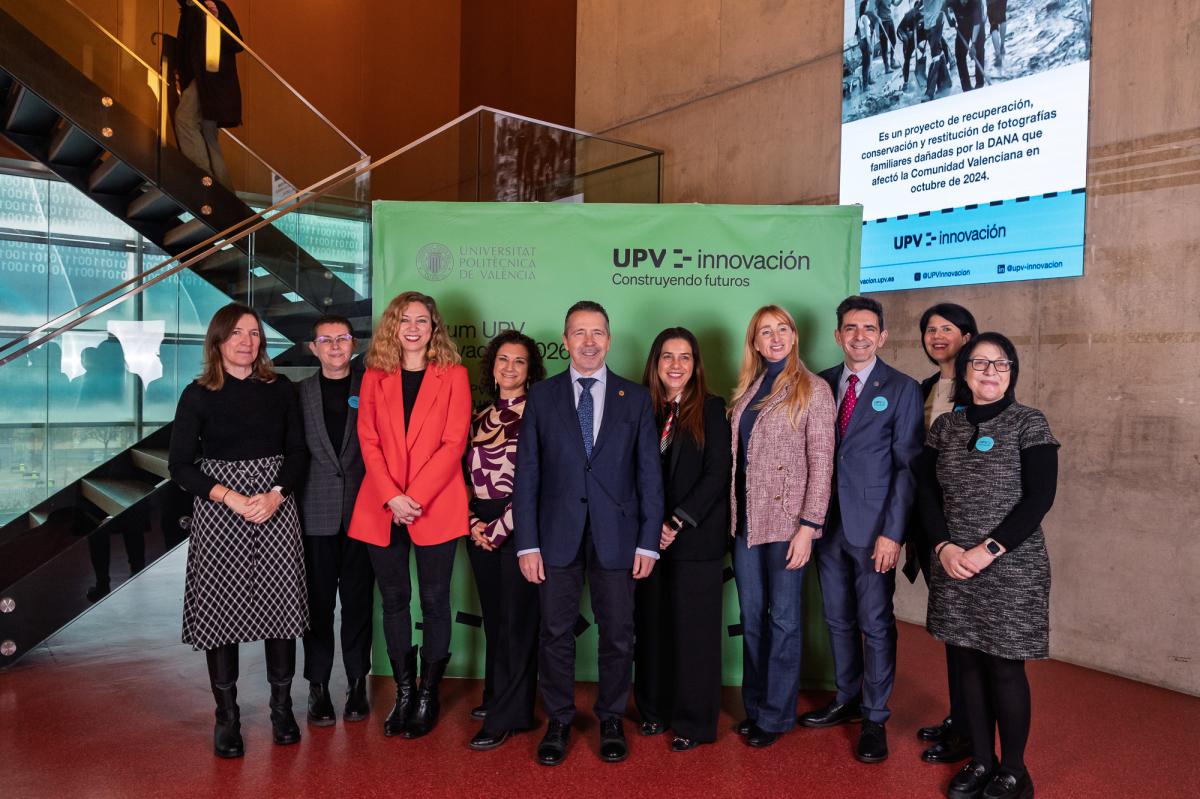
In his speech, he emphasised that the Universitat Politècnica de València goes beyond the traditional concept of a research university. “We are a university that acts as a driving force for our local and international environment,” he said, noting that the institution ranks among the top 100 universities in the world in numerous disciplines, reflecting the impact of its scientific and technological activity.
The Rector also highlighted UPV’s long-standing commitment to innovation and knowledge transfer, which he described as a fundamental part of the institution’s DNA. In this regard, he recalled that the UPV Innovation initiative was launched a decade ago, when he served as Vice-Rector for Research, Innovation and Transfer, with the aim of creating an ecosystem capable of connecting university research with society and the productive sector.
Capilla explained that innovation at UPV is supported by a broad network of structures and units working in coordination, including research institutes, the Social Council, the Integrated Employment Service, the Centre for Lifelong Learning and university entrepreneurship initiatives. “UPV goes far beyond the boundaries of our campuses,” he said, highlighting strategic alliances with organisations and research centres such as joint institutes with the CSIC, as well as strong collaboration with companies.
In this context, he underlined the growth in the creation of startups and spin-offs emerging from the university environment and noted that current results are the outcome of many years of sustained effort to build a strong innovation ecosystem.
During his address, the Rector also reflected on the changes transforming the concept of innovation at a global level. In particular, he pointed to the impact of artificial intelligence, which is reshaping the international scientific, technological and economic landscape while posing new challenges for universities. In his view, the rise of these technologies requires a rethinking of both educational content and learning processes, as well as the ways students access the labour market.
Capilla also announced new strategic projects aimed at strengthening UPV’s innovation ecosystem, including the upcoming tender for the TRL building, which will add 15,000 square metres of infrastructure dedicated to technology maturation and the expansion of the university’s business park. He also highlighted the role of the future UPV Caramelos site as a space designed to bring the university closer to citizens and strengthen its connection with society.
At the international level, the Rector stressed that universities must maintain a global outlook and collaborate with all major scientific and technological hubs worldwide. He noted that Europe will remain the university’s main framework for collaboration, particularly through European research programmes, while also advocating stronger cooperation programmes with Ibero-America.
He also highlighted opportunities for collaboration with China, where UPV has opened a campus in the digital city of Hangzhou, an advanced innovation environment where more than one billion euros have been invested in state-of-the-art laboratories. According to Capilla, this project positions the university as a strategic partner within an ecosystem that aims to promote international collaboration between universities and companies.
The event was also attended by the Regional Secretary for Universities, María Esther Gómez Martín, and the UPV Vice-Rector for Innovation and Knowledge Transfer, Salvador Coll.