santiago grisolía garcía
Santiago Grisolía García
doctor honoris causa
Santiago Grisolía García
Investit el 3 de desembre del 1991, per el rector de la Universitat Politècnica de València, Justo Nieto Nieto.
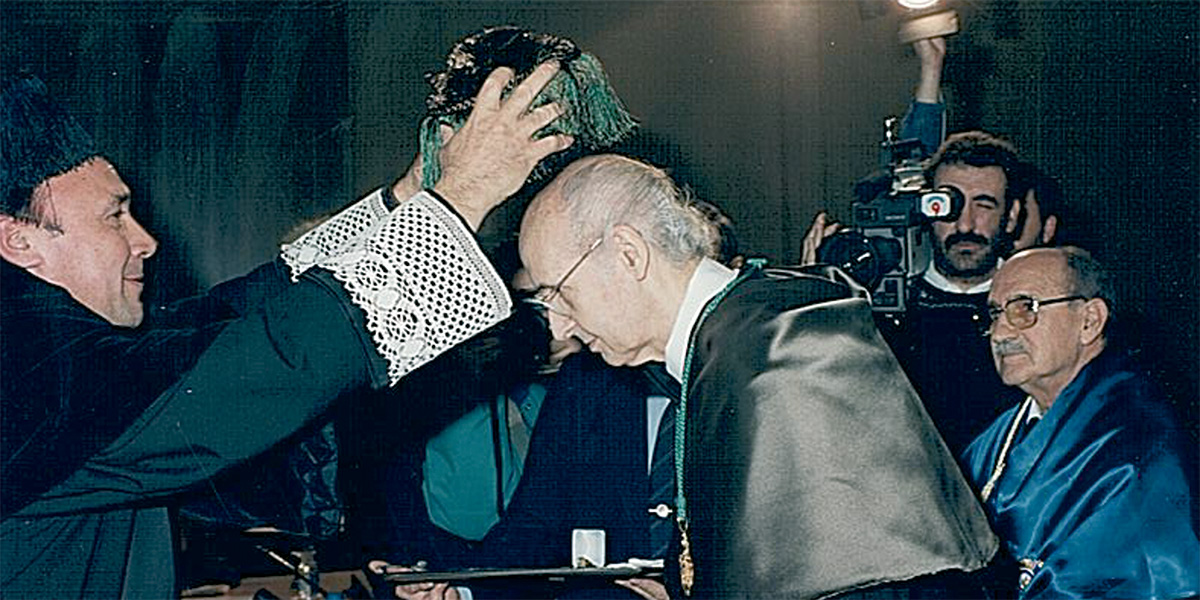

Santiago Grisolía García
Bioquímic espanyol reconegut per les seues investigacions en bioquímica i biomedicina, va presidir el Comitè de Coordinació Científica de la UNESCO i va fundar la Fundació Valenciana d'Estudis Avançats. El seu treball va ser crucial per a l'avanç de la ciència a Espanya.
The scientific work of Professor Grisolía belongs to the golden age of Enzymology and the discovery of metabolic cycles; in both aspects, his contribution at the forefront of the development of Biochemistry has been vital for the advancement of this science.
Santiago Grisolía was born in Valencia in 1923 and studied medicine at the Faculties of Madrid and Valencia, becoming one of the most brilliant students of his time.
In 1945, he won one of the ten scholarships offered by the Ministry of Education and Science for studies abroad, and in January 1946, he began collaborating with Professor Severo Ochoa in the United States, working on studies of the malic enzyme. Later, he joined the University of Chicago, where he pioneered the use of tracer isotopes to study metabolic pathways, using this technique to demonstrate the fixation of CO₂ in animal tissues.
In 1948, he was hired by the University of Wisconsin, where he made a decisive contribution to the understanding of the urea metabolic cycle.
In 1954, he worked at the University of Kansas as an Associate Professor and Director of the Medical Research Institute—a private foundation affiliated with the university.
In 1959, he was appointed full professor at Kansas, and in 1962, upon its creation, he became Director of the Department of Biochemistry. There he carried out outstanding work as both a teacher and researcher on the urea cycle, degradation of pyrimidine bases, glycolysis, and more—isolating the enzymes involved, clarifying reactions, and establishing new concepts about the nature of enzymatic action.
In 1974, he was named Distinguished Professor at the University of Kansas. In 1976, Grisolía took over the directorship of the Institute for Cytological Research, founded by the Valencia Savings Bank, where he carried out extraordinary work.
Grisolía was awarded the Prince of Asturias Prize, was granted honorary doctorates by numerous universities, was a member of the most prestigious scientific societies, a trustee of foundations and institutions, and President of UNESCO’s Human Genome Coordination Committee, among others. He also received some of the most distinguished decorations and held various honorary positions.
Contacta con nosotros
Accede a diferentes tipos de comunicación de la UPV: consultas, solicitudes, incidencias, sugerencias, quejas, felicitaciones...