robin thompson
Robin Thompson
doctor honoris causa
Robin Thompson
Investit el 8 de novembre del 2002, per el rector de la Universitat Politècnica de València, Justo Nieto Nieto.
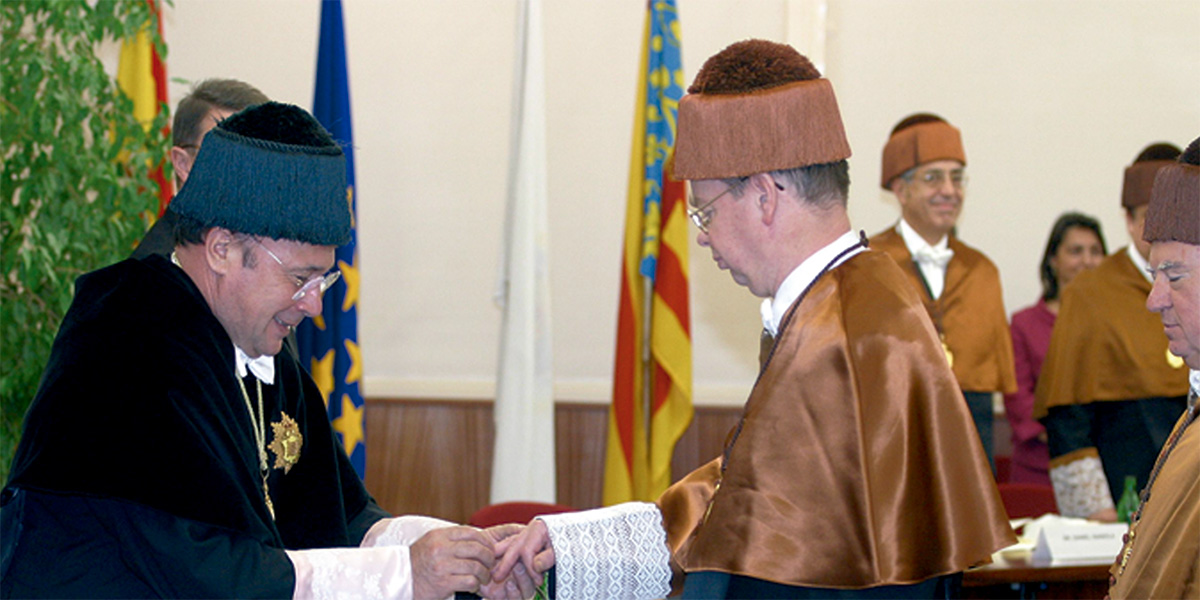

Robin Thompson
El Dr. Robin Thompson, expert en estadística aplicada a la genètica i biometria, va desenvolupar el mètode REML per a estimar la variabilitat en genètica animal. Va treballar en ARCUS, ÒBRIC i Rothamsted Research, i és membre de la Reial Societat d'Edimburg i professor honorari.
Dr. Robin Thompson grew up on a small dairy farm in the north of England and graduated in mathematics from the University of Newcastle, where he also earned a master’s degree in statistics. He completed his Ph.D. in Edinburgh with the dissertation titled Statistical Methods with Application to Animal Breeding. His professional career has focused on applied statistics in genetics and biometrics.
Between 1967 and 1983, he worked at the Agricultural Research Council Unit of Statistics (ARCUS), where he progressed through various positions until becoming Principal Scientific Officer and the main leader in the scientific area.
From 1983 to 1986, he worked at ABRO (Animal Breeding Research Organisation) in Edinburgh, where he led statistical and computational work. Between 1986 and 1993, he headed the Department of Genetics at the Institute of Animal Physiology and Genetics Research (IAPGR) in Edinburgh. From 1995 to 2000, he was Head of the Statistics Department at IACR, and since 2000 he has worked in the Biomathematics Unit at Rothamsted Research Station, continuing the research legacy of Fisher, Yates, and Nelder. The latter developed the GENSTAT statistical system and unified several areas of statistics through the introduction of generalized linear models.
Building on this foundation, Robin Thompson, together with Desmond Patterson, discovered a method for estimating variance components: the REML method, which stands for Restricted Maximum Likelihood. Since the 1980s, this method has become the standard procedure in quantitative animal breeding for estimating variance components, or equivalently, genetic parameters such as heritability or genetic correlation. He has also contributed to the development of suitable software to support this work.
He is an elected Fellow of the Royal Society of Edinburgh and an Honorary Professor at the Universities of Nottingham and London.
Career Timeline
1967–1983: Agricultural Research Council Unit of Statistics (ARCUS), Edinburgh
• 1967–1972: Scientific Officer
• 1972–1977: Senior Scientific Officer
• 1977–1983: Principal Senior Scientific Officer
1983–1986: Animal Breeding Research Organisation (ABRO), Edinburgh – Head of Statistics and Computing
1986–1993: AFRC Institute of Animal Physiology and Genetics Research (IAPGR), Edinburgh Research Station – Head of the Department of Genetics (promoted on individual merit)
1993–1995: BBSRC Roslin Institute (Edinburgh) – Head of Biometrics and Genetics Section
1995–2000: BBSRC IACR – Head of the Statistics Department
Since 2000: BBSRC Rothamsted Research Station – Head of the Biomathematics Unit
Contacta con nosotros
Accede a diferentes tipos de comunicación de la UPV: consultas, solicitudes, incidencias, sugerencias, quejas, felicitaciones...