rafael alberti
Rafael Alberti
doctor honoris causa
Rafael Alberti
Investit el 2 de octubre del 1995, per el rector de la Universitat Politècnica de València, Justo Nieto Nieto.
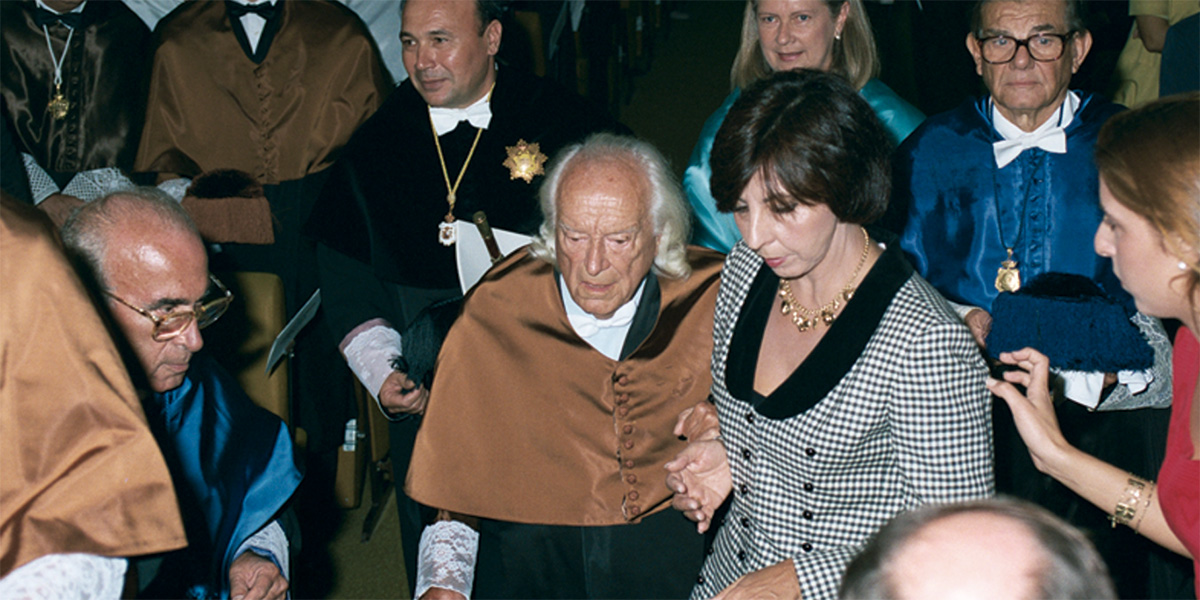

Rafael Alberti
Poeta espanyol de renom internacional, pertanyent a la Generació del 27. Reconegut per la seua poesia compromesa amb la realitat social i política, la seua obra és fonamental en la literatura espanyola del segle XX.
He was born in El Puerto de Santa María (Cádiz) on December 16, 1902. He moved to Madrid with his family in 1917. He began with painting but soon turned to literature, especially poetry, though he never entirely abandoned his first vocation.
At the age of 22, in 1925, he received the National Prize for Literature for a book of poetry, Marinero en Tierra (originally Mar y Tierra), written in 1924.
His work Sobre los ángeles (1928) shows his aesthetic connection with the Generation of ’27, the poetic pinnacle of the 20th century.
He was greatly influenced by Gil Vicente, whose work he became familiar with early on, in 1921, through Dámaso Alonso.
In 1926, on the occasion of the third centenary of the death of Góngora, he actively participated in reviving the work of the Cordoban culteran poet alongside Pedro Salinas, Gerardo Diego, Fernández Almagro, García Lorca, Jorge Guillén, Bergamín, Alfonso Reyes, and with the collaboration of Revista de Occidente, directed by Ortega y Gasset. Together they organized the tribute that served as a reparation for the neglect Góngora’s poetry had suffered for two centuries.
Alberti holds a prominent place among the universal Andalusian poets: Juan Ramón Jiménez, García Lorca, Machado… He published poems in the magazine Horizonte, directed by Pedro Garfias, and in Alfar magazine in the mid-1920s, a time when he lived at the Residencia de Estudiantes in Madrid with Buñuel, Dalí, Lorca, Prados, Huidobro, and others.
After the Spanish Civil War, in 1939, he began a long exile that took him first to France, then to Argentina, Uruguay, and Italy, from where he returned to Spain in 1977, the year he was elected to the Spanish Parliament (Diputado a Cortes).
De un momento a otro, Coplas de Juan Panadero, A la pintura, and Retornos de lo vivo lejano are poetry books from this period, along with his prose work La arboleda perdida, an evocative autobiographical memoir. El adefesio (1944) marked his contribution to theater, while he continued to focus on his favorite themes: the sea and the countryside, lullabies, bullfighting, and always, from afar, his longing for Spain.
In 1974, he was appointed a member of the Russell Tribunal.
His later poetic work is collected in Fustigada luz (1980) and Versos sueltos de cada día (1982).
In 1980, he was named Commander of the Arts and Letters of France.
In 1989, he became a member of the Royal Academy of Fine Arts of San Fernando and the Academy of Music of El Puerto de Santa María.
He received numerous awards, including: the Lenin Peace Prize (1965), Etna Taormina Prize (1975), Struga Prize (1976), Kristo Boteev Prize (Bulgaria, 1980), National Theater Prize (1981), Pedro Salinas Prize (1981), Miguel de Cervantes Prize (1983), Popular Vendimia Racimo de Oro Prize (Trebujena, Cádiz, 1983). He was awarded honorary doctorates by the following universities: University of Toulouse le Mirail (1982), University of Cádiz (1985), University of Havana (1987), and Polytechnic University of Valencia (1995).
Contacta con nosotros
Accede a diferentes tipos de comunicación de la UPV: consultas, solicitudes, incidencias, sugerencias, quejas, felicitaciones...