pedro duque
Pedro Duque
doctor honoris causa
Pedro Duque
Investit el 6 de octubre del 2005, per el rector de la Universitat Politècnica de València, Juan Juliá Igual.
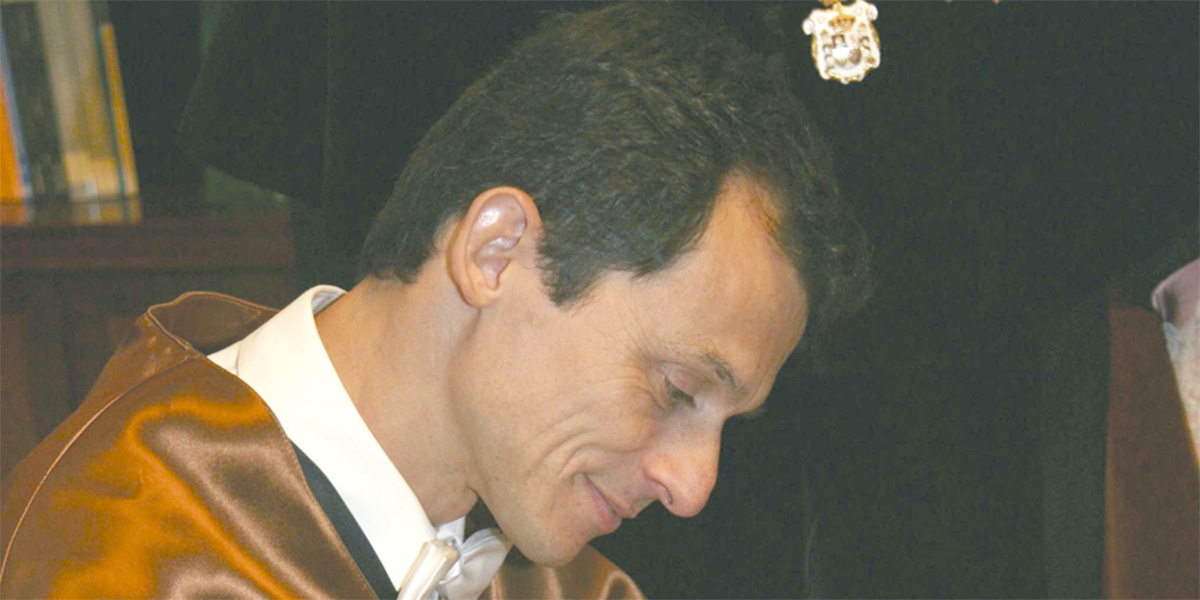
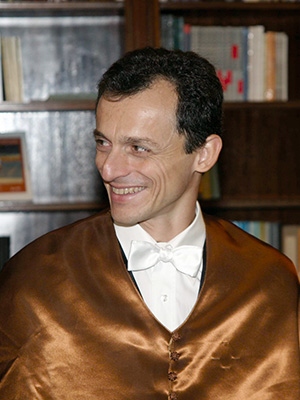
Pedro Duque
Enginyer aeronàutic i astronauta espanyol, va ser el primer espanyol a viatjar a l'espai en 1998. Exministre de Ciència i Innovació d'Espanya.
Pedro Duque was born on March 14, 1963, in Madrid. He is married and the father of three children.
He is the first Spanish astronaut to have traveled to space—and he has done so on two occasions. He trained at the Star City facility in Moscow (Russia) and in the United States. Between 1990 and 1992, he competed against more than 6,600 applicants vying to join the first astronaut team of the European Space Agency (ESA). After being selected, he continued his training at NASA’s facilities in the United States, where he was chosen as a backup for two missions.
His opportunity came on October 29, 1998, when he flew into space for the first time aboard the Discovery shuttle, serving as Flight Engineer No. 3. Five years later, Duque returned to space—this time traveling aboard a Russian Soyuz spacecraft to the International Space Station (ISS), where he spent ten days and carried out 25 experiments in fields such as biology, physiology, physics, Earth observation, education, and new technologies. These included operations with the Microgravity Science Glovebox, a scientific device developed in Europe.
Upon returning to Earth, the Madrid-born astronaut decided to devote part of his time to research and teaching at the School of Aeronautical Engineering (ETSIA) of the Autonomous University of Madrid, the same institution from which he graduated in 1986 with a perfect GPA of 10. Since August 2004, he has served as Director of Operations at USOC, the User Support and Operations Centre for the European Space Agency’s experimental facilities aboard the ISS.
Currently, while awaiting a third space mission, he balances his work at ESA with teaching duties as a professor at the School of Aeronautical Engineering of the Polytechnic University of Madrid.
Pedro Duque is a member of the Royal Academy of Engineering. He has received numerous honors, including the Order of Friendship from the Russian Federation; the Grand Cross of Aeronautical Merit (February 1999); and the 1999 Prince of Asturias Award for International Cooperation, which he shared with astronauts Chiaki Mukai, John Glenn, and Valery Polyakov, in recognition of their role as symbols of international cooperation in the peaceful exploration of space.
This is the first time Pedro Duque receives an honorary academic distinction from a Spanish university. For the Polytechnic University of Valencia, he is the second astronaut to be awarded the title of Doctor Honoris Causa—following Soviet cosmonaut Valentina Tereshkova, the first woman in space, who received the distinction in 1991.
Contacta con nosotros
Accede a diferentes tipos de comunicación de la UPV: consultas, solicitudes, incidencias, sugerencias, quejas, felicitaciones...