marcelino camacho abad
Marcelino Camacho Abad
doctor honoris causa
Marcelino Camacho Abad
Investit el 12 de desembre del 2001, per el rector de la Universitat Politècnica de València, Justo Nieto Nieto.

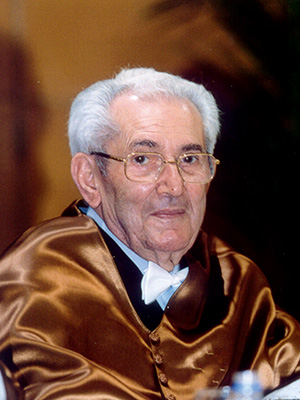
Marcelino Camacho Abad
Sindicalista i polític espanyol. Fundador de Comissions Obreres (CC.OO.) en 1957, va desafiar al règim franquista i va lluitar pels drets laborals. Empresonat diverses vegades, la seua lluita es va convertir en un símbol de resistència i justícia social a Espanya.
He was born on January 21, 1918, in Osma-La Rasa (Soria), into a family of railway workers.
At the age of 17, he joined the General Union of Workers (UGT) and the Communist Party of Spain. He remained active in the UGT until 1950. During the Spanish Civil War, he fought in the Popular Army of the Republic. Imprisoned in Tangier (1940–1941), he escaped and worked in the French Navy until 1957. Upon his return to Spain, he became a union liaison in the Workers’ Syndical Opposition (OSO) and later in what eventually became the Workers’ Commissions (CCOO), a trade union he co-founded along with Julián Ariza and others. Imprisoned many times under the Franco regime (1967–1972, 1972–1975, 1976), he was finally released when democracy was restored. One decisive moment for him was the General Assembly of Delegates of the Workers’ Commissions in Barcelona on July 12, 1976.
Until 1981, he was active in parliamentary work. He was elected as a Member of Parliament for Madrid (June 1977), was a member of the Executive Committee of the Communist Party of Spain (PCE), served as Secretary General of CCOO (1976–1987), and later as President of the union (1987–1996).
The trade union leader is considered one of the key figures during the Francoist period and the recovery of democratic freedoms in Spain. He criticized the Constitution’s “Ley de Hont” (D’Hondt Law) for disadvantaging smaller left-wing parties. He held membership card number 1 of the Workers’ Commissions. He was part of the famous Proceso 1.001, for which he was sentenced to 20 years in prison, later reduced to six. From prison, he actively contributed to the formation of the Democratic Junta and was the first leader of CCOO. After stepping down as Secretary General, he was appointed President and later expelled, along with another 950 union delegates. He has maintained a critical stance toward the CCOO leadership and was elected to the Federal Political Council of the United Left (IU).
He has received several awards: the Grand Cross of Civil Merit, the Order of Constitutional Merit, the Gold Medal for Merit at Work, the León Felipe Prize, Honorary Professor at the Complutense University of Madrid, the First Degree Order of Lázaro Peña from the Council of State of Cuba, among others. In 2002, a book about his life was published.
Now in his eighties, he continues to give lectures and participate in various events of all kinds. For many, his voice remains a symbol of the defense of workers’ rights.
Contacta con nosotros
Accede a diferentes tipos de comunicación de la UPV: consultas, solicitudes, incidencias, sugerencias, quejas, felicitaciones...