luis giménez lorente
Luis Giménez Lorente
doctor honoris causa
Luis Giménez Lorente
Investit el 12 de desembre del 2003, per el rector de la Universitat Politècnica de València, Justo Nieto Nieto.
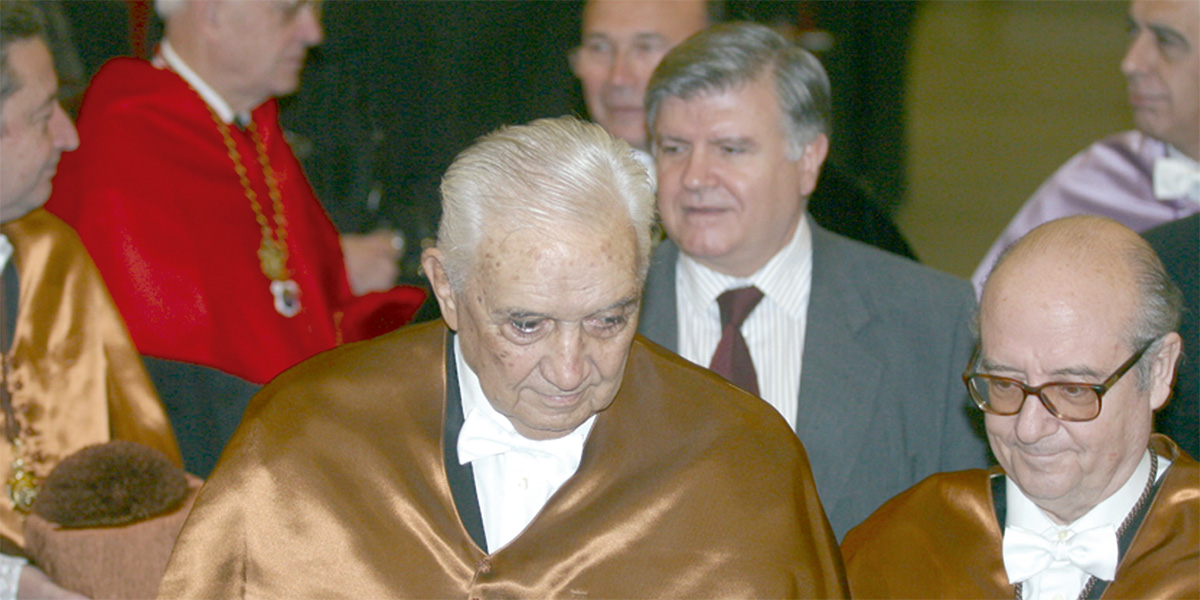
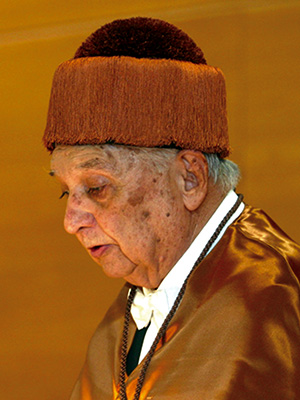
Luis Giménez Lorente
Col·leccionista de cartografia històrica valenciana. Membre destacat d'IMCOS i la Societat Espanyola de Cartografia, va dedicar la seua vida a adquirir i estudiar mapes, llibres i documents històrics. El seu llegat, incloent l'Atles de Joan Martines de 1570, enriqueix avui l'herència cultural de València.
Luis Giménez Lorente was born in Valencia in 1920. His passion for collecting began in the early 1950s when a great collector from Mallorca, Dr. Luis Alemany Vich, gifted him a small map of the Kingdom of Valencia by Tomás López Vargas. Studying this work introduced him to the fascinating world of cartography, leading him to acquire his first maps, specialized books, engravings, and historical Valencian documents, gradually shaping what are today known as the “VALENCIA” collections.
A member of IMCOS (the International Map Collectors’ Society), he presided over the International Assembly held in Madrid in 1992. He is also a member of the Spanish Society of Cartography, Photogrammetry, and Remote Sensing, where he has been listed as a researcher since 1989.
In 1984, Luis Giménez published a portfolio with reproductions of ten hand-colored maps from his collection. Two years later, he published a facsimile of Cantelli’s 1687 map, one of the most important in historical Valencian cartography.
At the History of Cartography Conference held in Madrid in 1994, he presented his collection for the first time. His presentation was included in the publication of the Spanish Society of Cartography.
In 1980, in Valencia, he acquired an unpublished Atlas by Joan Martines, a cartographer for King Philip II, signed in Messina in 1570. This Atlas became part of his cartobibliographic holdings and was later acquired by the National Library of Spain after being exhibited at the Naval Museum in Madrid. Only two other atlases by Martines are preserved in Spain: one dated 1577, owned by the Casa de Alba, and another from 1587, also dedicated to his monarch and now held at the National Library in Madrid.
After three years of research and study, the Joan Martines Atlas was presented in 1989 at the Historical Cartography Conference held in Madrid. Months later, it gained international recognition when it was published in the English journal of the International Map Collectors’ Society.
In 1995, the Institut Cartogràfic de Catalunya, on the occasion of the International Cartographic Conference, managed to gather at the Saló del Tinell in Barcelona the most important exhibition of Portolan charts ever held in Spain, bringing together almost all the charts and portolan atlases preserved in the country. A magnificent catalog was published, listing the 1570 Joan Martines Atlas as entry number twenty-four.
Since acquiring the Atlas, Luis Giménez’s goal had always been its dissemination. Under his direction, a facsimile edition of the Atlas was prepared with the utmost fidelity to the original, accompanied by several research papers.
On December 22, 1994, the facsimile was presented at the Naval Museum in Madrid, with the original displayed in the Discovery Room so that lovers of Historical Cartography could view and study it.
In April 1997, an exhibition titled “Valencian Historical Cartography” was organized by the Provincial Council of Valencia, bringing together magnificent national and foreign pieces. The exhibition featured the entire “VALENCIA” collection of Luis Giménez, and an excellent catalog was published, showcasing much of this collection.
He donated his rich collection of manuscripts, books, and maps to a foundation jointly administered by the Polytechnic University and his heirs. The donated holdings include the largest collection of maps of Valencia from the 16th, 17th, and 18th centuries. Undoubtedly, it is an authentic treasure consisting of 1,600 pieces, including 30 maps of Valencia, 48 books on cartography, prints of Valencian and maritime subjects, around a thousand engravings and books, 170 printed maps, and about 90 world maps, among others. His wish was for the collection to remain in Valencia.
Contacta con nosotros
Accede a diferentes tipos de comunicación de la UPV: consultas, solicitudes, incidencias, sugerencias, quejas, felicitaciones...