luis garcía berlanga
Luis García Berlanga
doctor honoris causa
Luis García Berlanga
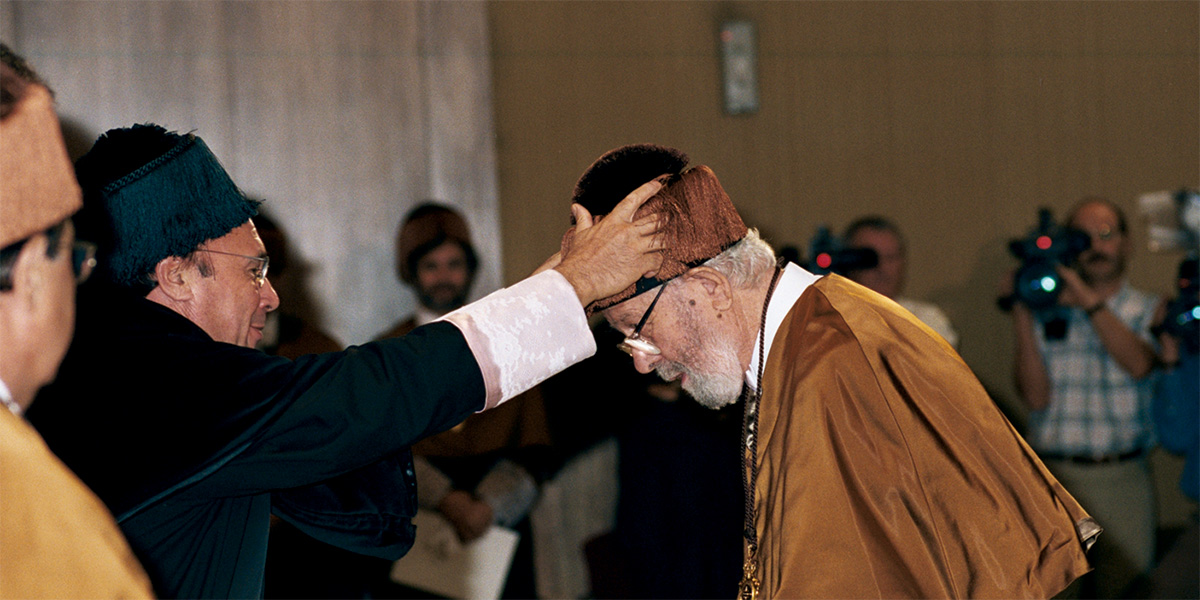
Investit el 2 de octubre del 1997, per el rector de la Universitat Politècnica de València, Justo Nieto Nieto.
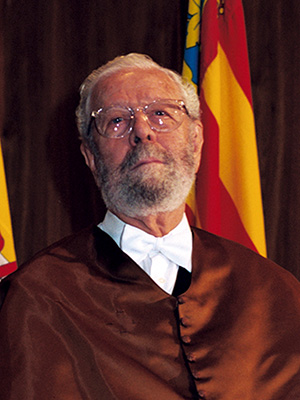
Luis García Berlanga
Cineasta espanyol, reconegut per la seua crítica satírica i humor negre en pel·lícules com a Benvingut, Mister Marshall i El botxí. La seua obra va influir notablement al cinema espanyol i europeu del segle XX.
Luis García-Berlanga Martí was born in Valencia on June 12, 1921. In the 1940s, he practiced painting and set design and worked as a film critic. He began studying Philosophy and Humanities until, in 1947, he moved to Madrid and enrolled at the Institute of Cinematographic Research and Experiences, becoming a member of its first graduating class and its very first graduate. Upon finishing these studies, he began his filmmaking career with the film Esa pareja feliz, from which he continued his trajectory as a film director up to París-Tombuctú, his most recent film to date.
Throughout all these years, García-Berlanga has held various positions related to cinema: he was a professor at the Official School of Cinematography, President of ADIRCE (the Spanish Directors Association), President of the Spanish Film Archive, and Honorary President of the Spanish Academy of Motion Picture Arts and Sciences, among others. He has also served as a jury member at numerous international film festivals, including Cannes, Venice, Berlin, San Sebastián, and Montreal. He is a member of the Valencian Council of Culture and has given lectures and talks at various cultural institutions such as Harvard University, the University of Southern California (Los Angeles), the University of Santa Barbara (USA), the Sorbonne and Europ 92 in Paris, the Spanish College in London, the Spanish College in Rome, and the Cervantes Institute in New York, among others. Moreover, a high school in Coslada (Madrid) and the Screenwriters School of the Menéndez Pelayo International University in Valencia bear his name.
He has received numerous national awards, including prizes from the National Entertainment Union, the Circle of Cinematographic Writers, the Valladolid International Film Week, the San Jorge of Barcelona, and the magazines Triunfo and Fotogramas, as well as the Goya Awards for Best Film and Best Director in 1994. He has also been honored with the ABC de Oro, the Pemán Journalism Prize (1990), the Gold Medal of the Círculo de Bellas Artes in Madrid and Valencia, the Award from the Community of Madrid, and the Gold Medal of the City of Madrid.
Internationally, he was awarded the Best Comedy Prize at the Cannes Festival in 1953 for Bienvenido Mr. Marshall; at the Venice Festival in 1956, the OCIC (International Catholic Organization for Cinema) Prize for Calabuch; and in 1963 at the same festival, El Verdugo received the Critics’ Prize. This same film later won the Grand Prize for Black Humor, awarded by the French Academy of Humor in 1965, and the Critics’ Prize at the Moscow Festival that same year. In 1961, Plácido was nominated by the Academy of Motion Picture Arts and Sciences for an Oscar as Best Foreign Film. Retrospectives and screenings of his films have been held in London, Moscow, Milan, Munich, Brussels, Paris, and in 24 American universities, as well as at the Academy of Motion Picture Arts and Sciences in Hollywood, which presented him with a commemorative plaque for screening El Verdugo, the first Spanish film ever shown at the Academy.
In recognition of his entire body of work, Luis García-Berlanga has received the Number One Prize at the European Film Festival in Rimini, the award as one of the ten most influential filmmakers in the world at the Karlovy Vary Festival, the Vittorio de Sica Award at the Sorrento Festival, and the International Golden Mercury Award.
He has been decorated with the Italian Order of Commendatore and has been proposed for the rank of Officer in the Order of Arts and Letters of the French Republic.
Books, essays, and monographs on his work have been written by critics and essayists such as José Mª Pérez Lozano, Diego Galán, Manuel Hidalgo, Juan Hernández Les, Julio G. Perucha, John Hoppeley, Antonio Gómez Rufo, Carlos Cañeque, and Juan Álvarez, among others.
In recent years, Luis García-Berlanga has received some of his most prestigious honors: the National Cinematography Award in 1980, the High Distinction from the Generalitat Valenciana in 1993, the Gold Medal for Fine Arts in 1981, the Prince of Asturias Award for the Arts in 1986, his induction as an Academician of the Royal Academy of Fine Arts of San Fernando in 1988, and the title of Doctor Honoris Causa from the Complutense University in 1989.
Films written and directed by Luis García-Berlanga include: Esa pareja feliz (1951), Bienvenido Mister Marshall (1952), Novio a la vista (1953), Calabuch (1956), Los Jueves, milagro (1957), Plácido (1961), La muerte y el leñador (Sketch from Las Cuatro verdades) (1962), El Verdugo (1963), La Boutique (original title: Las pirañas) (1967), Vivan los novios (1969), Tamaño natural (original title: Life Size) (1973), La Escopeta nacional (1978), Patrimonio nacional (1980), Nacional III (1982), La Vaquilla (1984), Moros y cristianos (1987), Todos a la cárcel (1993), Blasco Ibáñez (TV film for TVE) (1997), and París-Tombuctú (1999).
Contacta con nosotros
Accede a diferentes tipos de comunicación de la UPV: consultas, solicitudes, incidencias, sugerencias, quejas, felicitaciones...