luis blanes
Luis Blanes
doctor honoris causa
Luis Blanes
Investit el 19 de gener del 2005, per el rector de la Universitat Politècnica de València, Francisco J. Sanz Fernández.
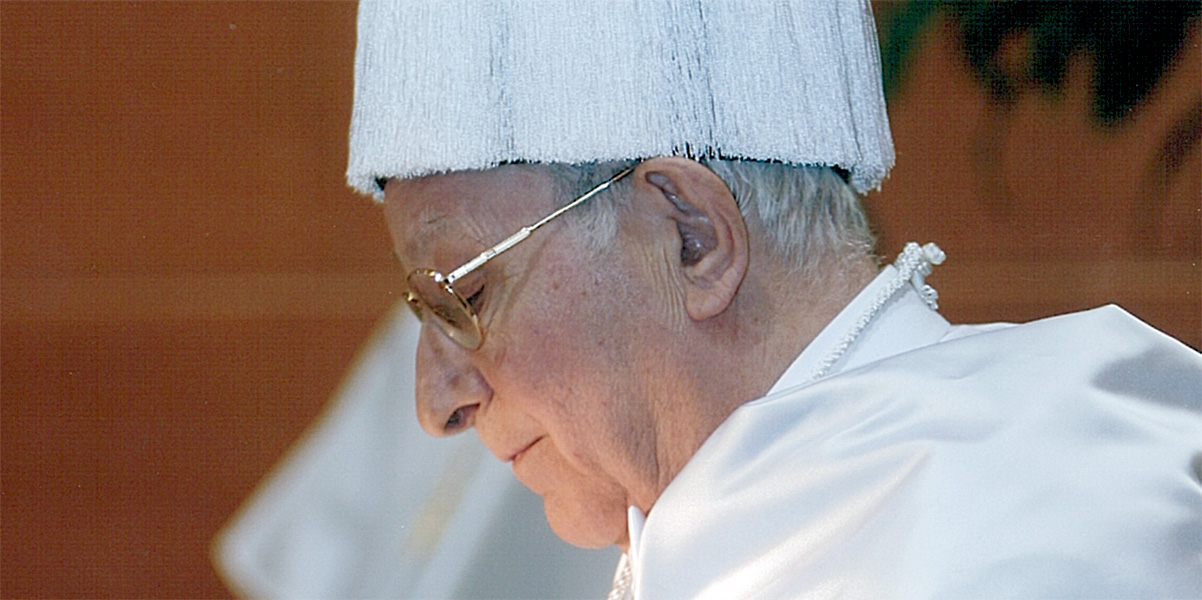
Luis Blanes
Compositor i musicòleg espanyol. Catedràtic de Contrapunt i Fugida a Sevilla i Harmonia a València, va compondre prop de 200 obres, incloent música coral, obres per a òrgan i cançons. Membre de l'Acadèmia de Belles arts de Sant Carles.
Luis Blanes was born in Rubielos de Moral in the Province of Teruel in 1929, although his family is from Alcoy and he has always maintained his link with the city.
He is considered to be one of the greatest Spanish composers and music researchers at present. He began his music training with professors from the stature of José Roca, Manuel Palau, Enrique González, Simona Ple, and Father Vicente Pérez-Jorge. Father Vicente Pérez-Jorge was a particular influence on his artistic career (he wrote his doctoral thesis about him in 1996, Personalidad del padre Vicente Pérez-Jorge a través de su música y de sus escritos [The personality of Father Vicente Pérez-Jorge through his music and writings]).
He is a Professor of Harmony at the Valencian Conservatory of Music and other Spanish centres. He has a wide range of choral work, both for chamber and group choirs, as well as having authored publications which are very commonly used in musical training, such as his Teoría y práctica de la Armonía Tonal (Theory and practice of tonal harmony). He is a champion of the reinstatement of musical studies at a university level and correcting the mistake made by acting Minister Severo Catalina on 17 June 1868 when he decided to remove
Music Studies from Universities. He is a major instigator for the Universidad Politécnica de Valencia offering its first doctorate degree in Music, the first Spanish university to do so. Demand for this degree continues to increase year after year.
A great admirer of Bach, his compositions demonstrate the continuous search and application of new systems of sound organisation and a great interest for new timbre combinations.
In 2002 he received the honour of being named Insigne de la Música Valenciana. The Comunidad Valenciana's Federation of Musical Societies in July 2004 awarded him the Euterpe Prize for Music Research, and on 19 May 2005 he was appointed Academic Researcher at the Valencian Music Academy.
In his honour, the ceremony finished with a performance by the Polifónico Choir from the Universidad Politécnica de Valencia, and a performance by soprano Emilia Onrubia who together with pianist Joseph Mardón played and sang various piano and vocal composition written by him.
Contacta con nosotros
Accede a diferentes tipos de comunicación de la UPV: consultas, solicitudes, incidencias, sugerencias, quejas, felicitaciones...