jose saramago
Jose Saramago
doctor honoris causa
Jose Saramago
Investit el 11 de maig del 1999, per el rector de la Universitat Politècnica de València, Justo Nieto Nieto.

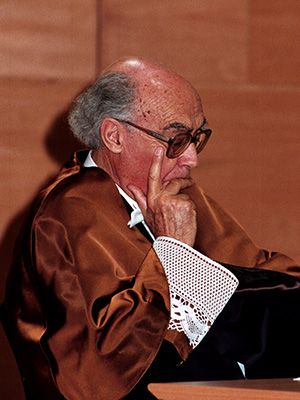
Jose Saramago
Conegut per la seua narrativa única i crítica social. Guanyador del Premi Nobel de Literatura en 1998, les seues obres inclouen Assaig sobre la ceguesa i L'evangeli segons Jesucrist.
Born in the deep heart of Portugal, in the village of Azinhaga, Ribatejo province, he grew up in Lisbon, where his parents moved when he was a child, although he never lost his ties with his birthplace, where he spent many stays throughout his life. He completed technical secondary studies, which adverse economic circumstances prevented him from continuing. After working in a mechanical sawmill, he held various other jobs, including editor, translator, and journalist, and for many years he carried out literary and production management at a publishing house. He later contributed as a literary critic for the magazine Seara Nova and worked as a cultural commentator. He was part of the first board of the Portuguese Writers’ Association, and from 1985 to 1994 he served as President of the General Assembly of the Portuguese Authors’ Association. Between 1972 and 1973 he was an editor for the magazine Diário de Lisboa and later Deputy Director of Diário de Notícias. Since 1976, he has dedicated himself exclusively to his literary work.
His literary output spans poetry, chronicles, travel writing, theatre, a five-volume diary titled Cuadernos de Lanzarote (1993–1997), short stories, and novels—the genre in which he achieved his greatest artistic recognition and widest international readership. In 1997, he published All the Names, an incursion into the Kafkaesque world of bureaucracy seen through a single character, Senhor José, a civil servant who lives an intense passion. In 2000, The Cave was published, offering a harsh vision of consumer society, its title referencing the scene described in Plato’s Republic. With this novel he completed the “Unintentional Trilogy” begun with Blindness and All the Names. In 2001, he published a second volume of his Cuadernos de Lanzarote and a children’s story written 25 years earlier titled The Biggest Flower in the World.
In April 1998, 55 prominent figures from Portugal’s cultural sphere responded to a Jornal de Letras, Artes e Ideias survey, placing Saramago at the top of the list of contemporary Portuguese writers.
The magical is always present in his work as an inseparable element of human ingenuity, which arises even under the harshest living conditions of ordinary people in the dark medieval world, in times of war, hunger, and superstition—as portrayed masterfully in Baltasar and Blimunda (Memorial do Convento), later adapted as an opera by Azio Corghi and premiered at the Teatro alla Scala in Milan under the title Blimunda, the novel’s unforgettable female protagonist. Corghi also adapted his play In Nomine Dei into the opera Divara, which premiered in Münster. Azio Corghi is also the composer of the cantata The Death of Lazarus, based on texts from Baltasar and Blimunda, The Gospel According to Jesus Christ, and In Nomine Dei, first performed at San Marco Church in Milan.
In his work—whether The History of the Siege of Lisbon, Land of Sin, The Year of the Death of Ricardo Reis, The Gospel According to Jesus Christ, or any other—his characters, some timeless and others grounded in a specific era, are necessary paradigms of human virtues and flaws.
Listing his participation in conferences and lectures would be endless; he has spoken at events in his own country and abroad. In Spain alone, by approximate count, he has given lectures in thirty-six cities, including Valencia, and many times in cities across Germany, France, England, Italy, the Netherlands, Belgium, Norway, Sweden, Switzerland, Russia, Czechoslovakia, the United States, Canada, Brazil, Mexico, Argentina, Uruguay, Cuba, and Venezuela.
Some of the awards Saramago received in recognition of his work include:
In Portugal: Critics’ Association Prize; Lisbon City Prize; Lisbon Municipality Prize; Portuguese PEN Club Prize (twice); Lisbon Literary Prize; Critics’ Prize; Dom Dinis Prize from the Casa de Mateus Foundation; Grand Prize for Novel and Romance from the Portuguese Writers’ Association; Literary Life Award from the Portuguese Writers’ Association; Grand Prize for Theatre from the Portuguese Writers’ Association; “Consagração” Prize from the Portuguese Authors’ Society; and the Luís de Camões Prize.
In Italy: Grinzane-Cavour Prize (Alba); Ennio Flaiano International Prize (Pescara); Brancati Prize (Zafferana); Mondello International Prize (Palermo); Scanno Prize – University Gabriele d’Annunzio (Chieti); and Penne–Moscow Prize (Penne).
In the United Kingdom: The Independent Foreign Fiction Prize (London).
In Spain: Rosalía de Castro Prize (Vigo); Archbishop Juan de San Clemente Prize (Santiago de Compostela); and the Jordi Xifra Heras European Communication Prize (Girona).
In recognition of his literary work, he was also awarded the following honors: Commander of the Military Order of Saint James of the Sword (Portugal); Knight of the Order of Arts and Letters (France); Doctor Honoris Causa by the Universities of Turin (Italy), Seville (Spain), Manchester (United Kingdom), Castilla-La Mancha (Spain), and Brasília (Brazil).
He was an honorary member of the Council of the Institute of Philosophy of Law and Historical-Political Studies of the University of Pisa (Italy); a member of the Universal Academy of Cultures (Paris); a corresponding member of the Argentine Academy of Letters; a member of the International Parliament of Writers (Strasbourg); a member of the Honorary Board of the César Manrique Foundation (Lanzarote, Canary Islands); Honorary Member of the Portuguese Authors’ Society (Lisbon); a member of the European Academy of Yuste (Yuste, Spain); and an Honorary Fellow of the Student Residence of the Carlos III University (Madrid, Spain).
On October 8, 1998, he was awarded the Nobel Prize in Literature. He was named Doctor Honoris Causa by the Polytechnic University of Valencia by decision of its Governing Board on January 21, 1999.
Contacta con nosotros
Accede a diferentes tipos de comunicación de la UPV: consultas, solicitudes, incidencias, sugerencias, quejas, felicitaciones...