josé antonio marina
José Antonio Marina
doctor honoris causa
José Antonio Marina
Investit el 26 de juny del 2003, per el rector de la Universitat Politècnica de València, Justo Nieto Nieto.

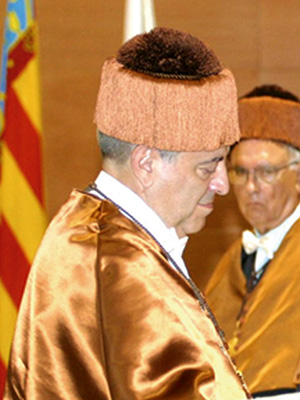
José Antonio Marina
Filòsof espanyol i catedràtic excedent de filosofia a la Cabrera. Es destaca per les seues investigacions sobre la intel·ligència i la creativitat, abordant temes des de l'ètica fins a la política. Col·labora en mitjans i és autor d'obres com El misteri de la voluntat perduda i Diccionari dels sentiments.
He was born in Toledo in 1939. A philosopher and versatile writer, he has succeeded in combining his research on intelligence with his work as a professor of Philosophy and his studies related to phenomenology, genetic psychology, neurology, and linguistics—fields that have occupied the last twenty-five years of his prolific career. The publication of his first book dates back to 1992, and his growing recognition has earned him numerous awards, making him one of the most notable Spanish thinkers today.
Among his major works are Theory of Creative Intelligence (1995), Ethics for Castaways (1996), The Sentimental Labyrinth (1998), Dictionary of Feelings (1999), The Mystery of the Lost Will (1998), The Flight of Intelligence (2000), Chronicles of Ultramodernity (2000), The Struggle for Dignity: Theory of Political Happiness (2000), The Jungle of Language (2002), The Puzzle of Sexuality (2002), and Verdict on God (2002).
In his first work, Praise and Refutation of Wit, he defines wit as an existential project that requires freedom. In 1995, he published Ethics for Castaways, where he argues that ethics is the most intelligent way to live. His book The Economic Creation is a review of mainstream economic theories from the perspective of corporate social responsibility. José Antonio Marina is regarded as the most influential philosopher on management issues and the most widely read and admired contemporary Spanish thinker. In his writings, he has defended the pursuit of a double unification between science, technology, and humanism: “Technology cannot solve any problem, only the people who direct technology can. What I oppose is submission to technology. There is a widespread belief that technology has a life of its own and is unstoppable, and that we will go wherever technology wants. People need to be warned that this is not true; technology comes from researchers and large corporations, and is therefore highly determined by people. If we begin to doubt our ability to guide technology, technology will end up guiding us. One thing is technology; another is the use made of it. That is where ethics comes in.”
José Antonio Marina sees violence between religions as absurd. In his view, religions have been the source of countless conflicts throughout history. Based on this, he argues for the need to transcend religion and create an “ethics” that would encompass the universal principles found at the heart of all major traditions. To be effective, he says, this ethics should be agreed upon by all peoples.
He maintains a regular presence in the media—press, radio, and television—and gives numerous lectures and courses at conferences, universities, companies, and professional associations. He is a regular contributor to El Mundo, El Semanal, and other publications, and has given several lectures at this University.
Awards
He has received numerous awards, including:
• Anagrama Essay Prize (1992)
• National Essay Prize
• Best Book of the Year Award from Elle Magazine
• Andrés Ferrer Journalism Prize
• Juan de Borbón Prize for Best Book of the Year
• DMR Economics Prize
• Giner de los Ríos Prize for Educational Innovation
Contacta con nosotros
Accede a diferentes tipos de comunicación de la UPV: consultas, solicitudes, incidencias, sugerencias, quejas, felicitaciones...