jorge garcés ferrer
Jorge Garcés Ferrer
doctor honoris causa
Jorge Garcés Ferrer
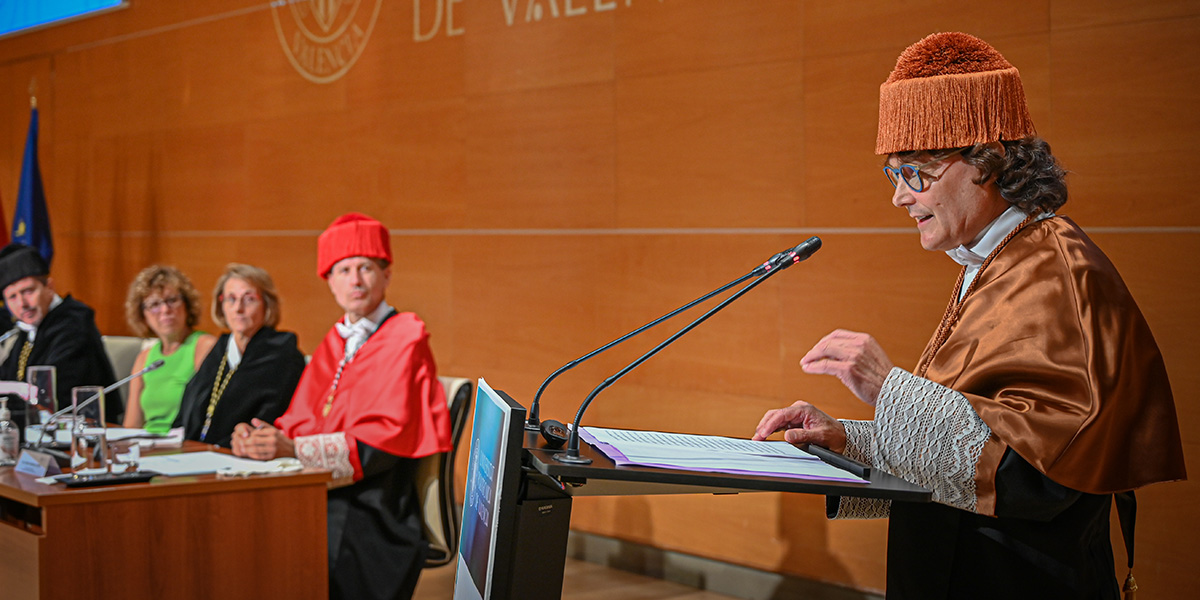
Investit el 9 de octubre del 2022, en l'acte de Apertura de curso académico 2022/2023 per el rector de la Universitat Politècnica de València, José E. Capilla Romá.
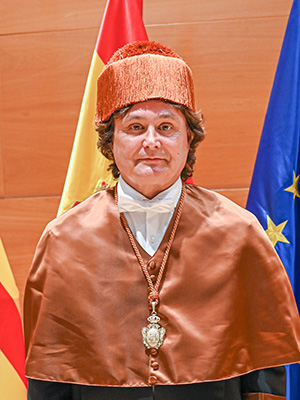
Jorge Garcés Ferrer
Catedràtic, investigador i expert en polítiques socials, destaca per la seua labor a la Georgetown University. Reconegut per la seua contribució en política social europea i cures de llarga duració.
Jordi Garcés Ferrer holds a PhD in Political Science and Administration (University of Granada, 2003), a PhD in Social Psychology (University of Valencia, 1985), a Bachelor’s degree in Philosophy and Educational Sciences with a specialization in Psychology (University of Valencia, 1982), a Diploma in Criminology (University of Valencia, 1981), and a Diploma in Social Work (University of Alicante, 1992).
During the academic years 2014, 2015, and 2016, he held the Prince of Asturias Chair at Georgetown University in Washington, D.C. (USA). He is currently a Full Professor at the University of Valencia and Director of the University Research Institute on Social Welfare Policy (Polibienestar) at the University of Valencia.
Professor Garcés has 37 years of continuous university teaching experience, from 1983 to the present, focusing on topics such as Comparative European Social Policies and Political Ideologies and Social Welfare. He has taught undergraduate, master’s, and doctoral courses at various European and North American universities, including the University of Valencia (Spain), Leopold-Franzens University of Innsbruck (Austria), Erasmus University of Rotterdam (Netherlands), and Georgetown University (Washington, D.C., USA).
Professor Garcés has received positive evaluations for 36 consecutive years of high-quality research (six six-year periods) from the Spanish National Agency for Quality Assessment and Accreditation (ANECA). His research activity has been carried out both at the University of Valencia and at other universities and research centers where he has served as a visiting professor and/or researcher, including: George Washington University (USA); Instituto Superior de Ciências da Saúde-Sul in Lisbon (Portugal); Université Paris Dauphine XI (France); University of Kent in Canterbury (United Kingdom); Universidad San Pedro (Peru); Oxford University (United Kingdom); Cambridge University (United Kingdom); Universidad Autónoma de Encarnación (Paraguay); Leopold-Franzens University of Innsbruck (Austria); and Erasmus University of Rotterdam (Netherlands).
Professor Garcés is the author or co-author of more than 100 scientific publications in Spanish, Valencian, English, and German, including books, book chapters, and journal articles published by internationally renowned publishers such as McGraw-Hill, Palgrave MacMillan, Peter Lang, Routledge, and Nova Science. His work has appeared in leading journals such as Archives of Gerontology and Geriatrics, Health Policy, International Journal of Geriatric Psychiatry, and Health and Social Care in the Community, among others.
In the field of research, Professor Garcés founded the Social Welfare Policy research group Polibienestar at the University of Valencia in 1996, which later became a University Research Institute. He has served as its Director since its creation. The mission of the Polibienestar Institute is to improve social welfare and quality of life through interdisciplinary research that bridges technical and social sciences.
Currently, Polibienestar includes 56 researchers from nine different departments of the University of Valencia, along with six Associated Units from the universities of Jaume I, Murcia, Castilla-La Mancha, Castilla y León, Extremadura, the Basque Country, and the Polytechnic University of Madrid. It is recognized as an international center of research and excellence in public policy with an interdisciplinary approach (www.polibienestar.org).
From this institute, Professor Garcés has led major international research projects of the highest level, primarily funded by the European Commission’s 6th and 7th Framework Programmes and Horizon 2020.
Two key principles underpin Professor Garcés’s research work. First, an interdisciplinary approach, bringing together experts from a wide range of scientific disciplines to study social and health phenomena. Specialists in medicine, engineering, computer science, architecture, sociology, political science, psychology, economics, law, social work, and education collaborate to analyze and advance social welfare policy.
Second, his teams include interinstitutional networks composed of research institutes and centers, public administrations, private companies, and nonprofit social organizations, with the aim of enhancing commitment and effectiveness in implementing public social welfare policies.
These two dimensions foster continuous learning within the team, promote cross-cutting knowledge, and allow for a shared definition of research processes from both basic and applied perspectives.
Throughout his academic career, Professor Garcés has held various academic leadership positions at the University of Valencia, actively participating in both teaching and research management. In this regard, he has served as a member of the Governing Council of the University of Valencia, Director of the Faculty of Social Work, Director of the Official Master’s Program in Social Welfare at the Faculty of Social Sciences, and founder and director of the Polibienestar Research Institute at the University of Valencia, among others.
He has also organized and led several international scientific events, including the 2009 European Conference “Living-All” on the free movement of people with disabilities in Europe, and the 2012 Conference “BE supportive, NOT violent!” on positive parenting models in Europe. Notably, he was appointed by the ESPAnet Organizing Committee (European Network for the Analysis of European Social Policy) as President of its 9th International Conference, which was held in Valencia in 2011 under the theme “Sustainability and Transformation of European Social Policy.”
In addition, he has promoted the creation of the Spanish Society for Socio-Health Care, the Tourism Technology Platform (THINKTUR) of the Spanish Ministry of Science and Innovation, the European Network of Social Authorities for Youth (ENSA-Y), and two Excellence Micro-clusters in collaboration with the University of Valencia, the Polytechnic University of Valencia, and the Spanish National Research Council (CSIC), in the field of new technologies for active and healthy aging.
During the 2013–2014 academic year, Professor Garcés was awarded the Prince of Asturias Chair at Georgetown University, a position competitively granted by the Spanish Ministry of Education, Culture, and Sports as part of a public call for applications under the agreement signed with Georgetown University, the Embassy of Spain in the United States, and the Endesa Foundation.
The Prince of Asturias Chair at Georgetown University was established in 1999 in honor of the Prince of Asturias, HRH Prince Felipe of Bourbon and Greece, now King Felipe VI of Spain, who completed his graduate studies at the Edmund A. Walsh School of Foreign Service at Georgetown University.
Upon his appointment to the Prince of Asturias Chair at the BMW Center for German and European Studies within the Walsh School of Foreign Service, and in line with the Chair’s objectives, Professor Garcés engaged in teaching and research activities aimed at promoting and disseminating knowledge on Spain and Europe in the field of Comparative European Social Policies. He also assumed the institutional representation of the Chair before academic, scientific, economic, social, and diplomatic institutions and figures in the United States.
In this regard, and with the goal of contributing to the dissemination and promotion of Spanish university science and research, Professor Garcés has held bilateral meetings between the Prince of Asturias Chair and various international institutions based in Washington, D.C., including the World Bank, the International Monetary Fund, the Inter-American Development Bank, the Organization of American States, the Pan American Health Organization, and the Delegation of the European Commission to the United States.
He has also collaborated with prestigious U.S. think tanks such as the Brookings Institution, the Wilson Center, the Peterson Institute for International Economics, the Center for Strategic and International Studies, and the Council on Foreign Relations.
Special mention should be made of the outstanding work carried out by Professor Garcés, in collaboration with the Spanish Embassy in Washington, D.C., in the promotion and consolidation of the first Association of Spanish Scientists in the United States (ECUSA), where he delivered the keynote lecture at the association’s inaugural event in the U.S., titled: “Interdisciplinarity: An Opportunity for Innovation.”
Together with this scientific association, the Spanish Foundation for Science and Technology (FECYT), and the Spanish Embassy, and within the framework of the Prince of Asturias Chair, he organized the First Congress of Spanish Scientists in the United States in September 2015. The event was supported by the Ramón Areces Foundation, “la Caixa” Foundation, and Endesa Foundation, and was held under the honorary presidency of Their Majesties the King and Queen of Spain.
He currently serves as Counselor for Education and Universities at the Permanent Delegation of Spain to the OECD, UNESCO, and the Council of Europe—a diplomatic position of the Spanish Government based in Paris (France), which he has held since September 2020.
Contacta con nosotros
Accede a diferentes tipos de comunicación de la UPV: consultas, solicitudes, incidencias, sugerencias, quejas, felicitaciones...