joaquín rodrigo vidre
Joaquín Rodrigo Vidre
doctor honoris causa
Joaquín Rodrigo Vidre
Investit el 31 de maig del 1988, per el rector de la Universitat Politècnica de València, Justo Nieto Nieto.

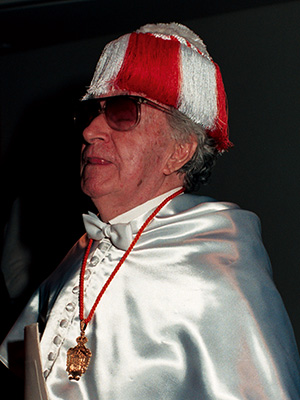
Joaquín Rodrigo Vidre
Compositor espanyol, famós pel seu Concert d'Aranjuez per a guitarra i orquestra. La seua obra va influir profundament en la música clàssica espanyola del segle XX.
Joaquín Rodrigo is undoubtedly the most prestigious living Spanish musician in the world.
He was born in Sagunto on November 22, 1901. In 1905, he lost his sight as a result of a diphtheria epidemic. In 1906, he moved with his family to Valencia.
He studied music theory with J. Julián, piano with R. Ribes, and harmony and composition with F. Antich in Valencia, and received advice from Francisco Enrique Gomá and Eduardo López Chavarri.
In 1922, he traveled to Germany, where he studied independently and wrote his first scores, including Juglares for orchestra, which premiered in Valencia in 1924.
“Cinco piezas infantiles” for orchestra won a national prize in 1925. Between 1927 and 1932, he lived in Paris. He took composition classes with Paul Dukas, becoming his favorite student, at the École Normale de Musique de Paris.
He met Manuel de Falla and struck up a deep friendship with him. During those years, he also met pianist Victoria Kamhi, a certified teacher at the Paris Conservatory, whom he married in 1933.
His recognition in Paris is evidenced by the numerous early Parisian editions of his works.
Returning to Spain in 1933, he obtained the Conde de Cartagena Scholarship, which allowed him to settle back in Paris, where he studied music history in depth with Maurice Emmanuel and Pirro, and from where he toured Germany, Austria, and Switzerland.
In 1934, he won first prize from the Círculo de Bellas Artes de Valencia for his symphonic poem “Per la flor del lliri blau.”
In 1935, his teacher Paul Dukas died, and in his memory he composed the “Sonada de adiós” for piano.
In June 1936, he left for Germany with his wife before the Spanish Civil War broke out. As a result of the war in Spain, the Conde de Cartagena scholarship he had been enjoying was suspended, plunging the musician into a difficult financial situation.
Between 1936 and 1938, he lived in Paris, Freiburg, and Salzburg. In 1938, he taught summer courses at the University of Santander despite the difficulties of the situation in Spain.
In 1935, he composed the “Concierto de Aranjuez” in Paris. Upon their return to Spain, the Rodrigos settled permanently in Madrid in 1939, and in 1940 he premiered the Concierto de Aranjuez, his greatest success and the basis of his worldwide popularity, despite being a work that represents only a partial aspect of his complex personality as a composer, less known in other areas of considerable interest.
During the 1940s, he was head of the National Organization for the Blind in Spain and began his collaborations as a music critic. From 1940 and for more than a decade, he was also a music advisor for Radio Nacional.
In 1942, he won the National Music Prize for his “Heroic” concerto for piano and orchestra. He worked as a critic for the newspaper Pueblo. Years later, he wrote for the newspapers “Marca” and “Madrid.”
During 1944 and 1945, he held a management position in the Music Department of Radio Nacional.
In 1945, he received the Order of Alfonso X the Wise.
In 1947, he was the creator and professor of the Manuel de Falla Chair of Music at the Faculty of Philosophy and Letters of the Complutense University of Madrid.
In 1948, he won first prize for “Ausencias de Dulcinea” in the Cervantino competition held to mark the 4th centenary of the birth of Miguel de Cervantes.
In 1950, he became a member of the Royal Academy of Fine Arts of San Fernando in Madrid.
He taught music history at the University of Madrid.
In 1953, he was awarded the Grand Cross of the Order of Alfonso X the Wise.
In 1954, he became vice president of the Spanish Section of the International Society for Contemporary Music (ISCM).
In 1955, he premiered “Fantasía para un gentilhombre” in San Francisco, California, commissioned by guitarist Andrés Segovia.
In 1960, he received the Order of “Officier des Arts et Lettres” in Paris.
In 1963, he was awarded the Order of Knight of the Legion of Honor. He moved to Puerto Rico to teach a course on the history of music at the University of Río Piedras, where he remained until February 1964. His daughter, Cecilia, married violinist Agustín León Ara.
In 1964, he received an honorary doctorate from the University of Salamanca.
In 1966, he was awarded the Grand Cross of Civil Merit and the Gold Medal for Merit in Work.
In 1967, he became a member of the European Society of Culture.
In 1969, he was named an Honorary Member of the Royal Academy of San Carlos in Valencia.
In 1975, he was awarded the Silver Spur in Mexico. He received an honorary doctorate from the University of Los Angeles.
In 1976, he became an honorary member of the Ateneo de Madrid.
In 1978, he became a member of the Académie des Sciences des Lettres et des Beaux-Arts de Belgique (filling the vacancy left by Benjamin Britten).
In 1980. Gold Medal for Merit in Fine Arts.
In 1982. National Music Prize. Honorary Doctorate from the University of Southern California.
In 1987. Gold Medal and Honorary Member of the Generalitat de Valencia.
In 1988. Honorary Doctorate from the Polytechnic University of Valencia. Director of the Royal Academy of Fine Arts of San Fernando in Madrid.
In 1989. Gold Medal from the Complutense University of Madrid. Honorary Doctorate from the University of Alicante. Honorary Doctorate from the Complutense University of Madrid. Medal for Artistic Merit from the City of Madrid. Honorary Advisor to the Society of Authors and Publishers (SGAE).
In 1990. Honorary Doctorate from the University of Exeter. Gold Medal of Madrid.
In 1991. Knight of the Royal Order of Santa María del Puig de Valencia. Silver Seal of the City Council of Valencia. First edition of the Guerrero Foundation Award for Spanish Music. Received the noble title of Marquis of the Gardens of Aranjuez, granted by His Majesty Juan Carlos I.
In 1992, he was awarded the First Class Order of Félix Varela by the Government of Cuba. He was made an honorary member of the Royal Academy of Valencian Culture.
In 1994, he received the Gold Medal from the Círculo de Bellas Artes de Valencia.
In 1995, he received the Gold Medal from the Royal Conservatory of Music in Madrid and the Ondas Classical Music Award. Distinction of the Valencian Regional Government for Cultural Merit.
In 1996. Prince Felipe of Asturias Award for the Arts. Gold Medal of Sagunto. Joaquín Rodrigo Commemorative Medal, issued by Schott Musik. Grand Cross of the Civil Order of Social Solidarity. Gold “Star” of the Community of Madrid. Gold Medal of Sagunto.
In 1997, he received the Gerión Prize for the Arts. His wife Victoria Kamhi died on July 21.
In 1998, the French government promoted him to the rank of Commendeur des Arts et des Lettres. He received the SGAE and AIE Prize for Best Classical Music Composer. He was awarded the Medal of Honor from the Menéndez Pelayo International University in Santander.
In 1999, he received the Gold Medal of the Granada Festival. He died on July 6 in Madrid. His remains rest in the family pantheon in the cemetery of Aranjuez.
Rodrigo Festivals have been held in Turkey and Japan.
Religious works
1954. Ave Maria for choir. 1963. Wedding hymns. Hymns of the neophytes of Qumran.
Works for orchestra
1923. Juglares. Cançoneta for violin and string orchestra. 1925. Five pieces for children. 1927. Three old dance tunes. 1928. Prelude to a poem on the Alhambra. 1930. Distant zarabanda and Christmas carol for string orchestra. 1934. Per la flor del lliri blau. 1935. Two Berceuses. 1939. Deux miniatures andalouses. Concierto de Aranjuez. 1942. Heroic Concerto for Piano and Orchestra. 1943. Concierto de Estío for Violin and Orchestra. 1945. Two chivalrous pieces for cello orchestra. 1948. “Ausencias de Dulcinea” (Absences of Dulcinea), based on a text by Cervantes, for four sopranos, bass, and orchestra. 1949. “Concerto in modo galante” (Concerto in gallant style), for cello and orchestra. 1953. Soleriana. 1955. Homage to Sagunto. 1957. Music for a Garden.
More recent works include
1952. Serenade Concerto for harp and orchestra. 1954. “Fantasy for a Gentleman,” for guitar and orchestra. 1963. Sones en la Giralda for harp and orchestra. 1966. Madrigal Concerto for two guitars and orchestra. 1967. Andalusian Concerto for four guitars and orchestra. 1976. In Search of the Beyond. 1981. Concerto as a Divertimento for cello and orchestra. 1982. Castanets and Tambourines for orchestra.
Works for voice and orchestra
1935. Triptych by Mossén Cinto Verdaguer. Four Songs in Catalan. 1948. Romance of the Commander of Ocaña. 1952. Christmas Carols and Songs.
Chamber Music
1923. Two sketches for violin and piano. 1929. Siciliana for cello and piano. 1938. En los trigales, for guitar. 1943. Rumaniana for violin and piano. Tiento for guitar. 1944. Capricho for solo violin. 1958. Impromptu for harp.
More recent
Fandango for guitar. 1966. Sonata pimpante for violin and piano. Aria antigua for flute and piano 1972. Pájaros de primavera for guitar.
Pieces for piano
1923. Suite. Berceuse de otoño. 1926. Preludio al gallo mañanero. Bagatela. Pastoral. 1928. Spring Berceuse. 1929. Air de ballet sur le nom d'une jeune fille. 1931. Spanish Serenade. 1935. Farewell Sonata. 1936. 4 Dances of Spain. 1941. 3 Dances of Spain. Grand March of the Undersecretaries, for four hands. 1942. Mimina's Album. 1945. In the Shadow of Torre Bermeja. 1951. Five Sonatas of Castile. 1964. Twilight over the Guadalquivir. 1972. Dance of the Poppy. 1975. Sunset. 1977. Sonatina for Two Dolls.
Pieces for voice and piano
1925. Cantiga “Muy graciosa es la doncella”. 1928. Romance de la infantina de Francia. Serranilla. 1034. Cançó del teuladí. Cántico de la Esposa. Esta niña se lleva la flor. Estribillo y.....? 1934. Soneto. 1935. Coplas del pastor enamorado Fino cristal. 1937. Canción del cucú. 1939. Canción del grumete. Trovadoresca.
Choral music
1933. Jo tinc un burro. 1950. Triste estaba el Rey David. Sephardic songs from the 15th century. 1953. Music for a Salmantino Codex
Lyric Theater
1950. Stage Music for “Life is a Dream” 1951. “Contempt with Contempt” 1953. “Oedipus” 1957. ‘Thyestes’ 1960. “The Pretend Son” (based on a comedy by Lope de Vega) 1975. “Sónica la Cortesana”
Ballets
1955. Pavana Real 1956. Juana y los caldereros.
Contacta con nosotros
Accede a diferentes tipos de comunicación de la UPV: consultas, solicitudes, incidencias, sugerencias, quejas, felicitaciones...