jean dausset
Jean Dausset
doctor honoris causa
Jean Dausset
Investit el 28 de juny del 2002, per el rector de la Universitat Politècnica de València, Justo Nieto Nieto.
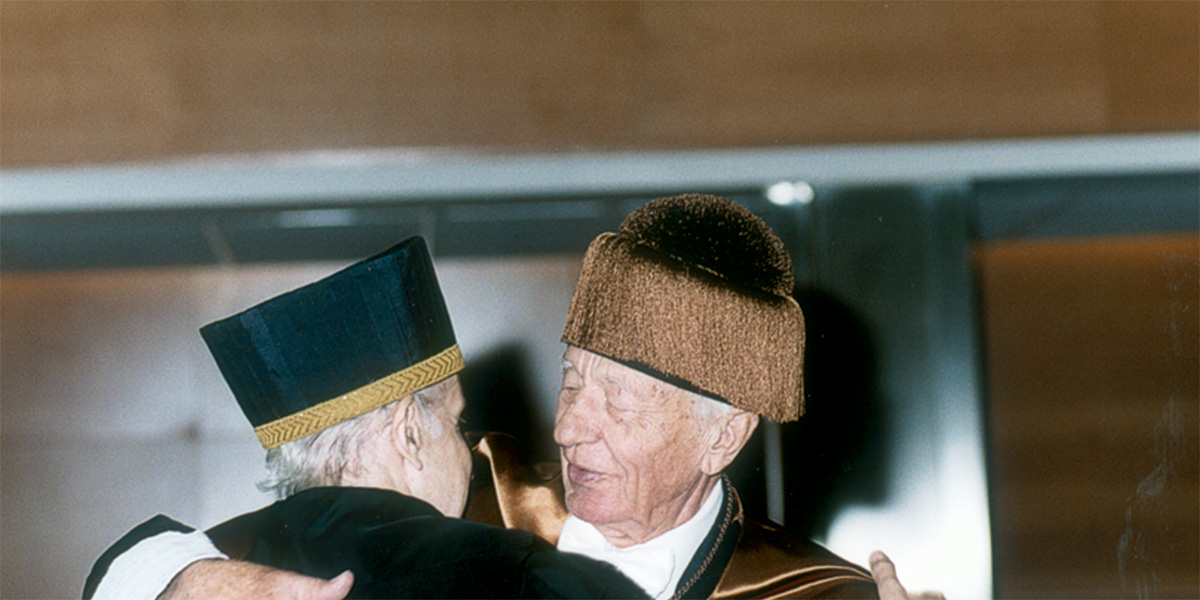
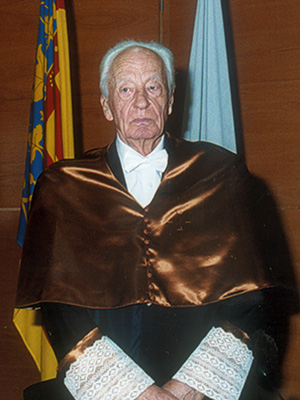
Jean Dausset
Immunòleg francès, guardonat amb el Premi Nobel de Fisiologia o Medicina en 1980 pels seus descobriments sobre els antígens d'histocompatibilitat. La seua investigació va revolucionar la comprensió de les malalties autoimmunes i les trasplantes d'òrgans.
Born on October 19, 1916, in Toulouse, he earned his Doctor of Medicine degree from the Faculty of Medicine in Paris in 1945. He served as an intern and later as an associate physician in the Paris Hospitals and joined the army in Morocco in 1941. He worked as a hematologist during the Tunisia campaign (1943) and the Normandy campaign (1945). After World War II, he dedicated himself to research, first at the Regional Blood Transfusion Center and later at the National Center. He worked very actively alongside Professor Robert Debré in the creation of the University Hospital Centers (1955–1958). In 1952, he was the first to observe massive leukoagglutination. In 1958, he described the first leukocyte antigen (Mac) of what would become the HLA (Human Leukocyte Antigen) system. He was appointed Associate Professor in 1958 and later Professor of Immunohematology at the Faculty of Medicine in Paris (1968). In 1977, he assumed the Chair of Experimental Medicine at the Collège de France.
Scientifically, he devoted his life to studying the HLA system, which groups the genes of an individual’s specific antigens, demonstrating its importance in transplants through skin grafts carried out on volunteer patients. He published the first studies on the possible association between HLA tissue groups and diseases. In 1972, he organized anthropological research that defined HLA groups within different populations. In 1969, he founded France-Transplant. The Research Unit of the National Institute of Health and Medical Research, which he directed at Saint-Louis Hospital from 1968 to 1984, described numerous antigens of the HLA system and made significant contributions to studies on the individual’s immune response.
In 1983, Jean Dausset created the Centre for the Study of Human Polymorphism, based at the Collège de France, which contributed to deciphering the human genome map and identifying genes related to genetic diseases. He also contributed to the study of HLA molecules known as “tolerance” molecules, particularly the HLA-G molecule, which is responsible for inhibiting the mother’s immune reaction against her incompatible fetus. HLA-G plays a vital role in preventing rejection.
Honors and Distinctions
He was awarded honorary doctorates by the University of Brussels (1977), Genoa (1977), Liège (1980), Lisbon (1982), Rome (1985), Zagreb (1986), Lima (1990), Complutense University of Madrid (1991), Buenos Aires (1995), Las Palmas (1995), Quebec (1996), Zaragoza (1996), and Cagliari (1997).
He was a member of the Academy of Sciences of the Institut de France (1977), the Academy of Medicine (1977), and a foreign member of the American Academy of Arts and Sciences (1979) and the National Academy of Sciences (1980).
He received the Grand Prize for Chemical and Natural Sciences (1967), the Silver Medal of the CNRS (1967), the Grand Scientific Prize of the City of Paris (1968), the Cognacq-Jay Prize from the Academy of Sciences (1969), the Gairdner Foundation Award (1977), the Koch Foundation Prize (1978), and the Wolf Prize (1978).
In 1980, he was awarded the Nobel Prize in Physiology or Medicine, followed by the Honda Prize (1988), the Jiménez Díaz Foundation Prize (1990), and the Medawar Prize (1996).
Contacta con nosotros
Accede a diferentes tipos de comunicación de la UPV: consultas, solicitudes, incidencias, sugerencias, quejas, felicitaciones...