francisco javier benedicto
Francisco Javier Benedicto
doctor honoris causa
Francisco Javier Benedicto
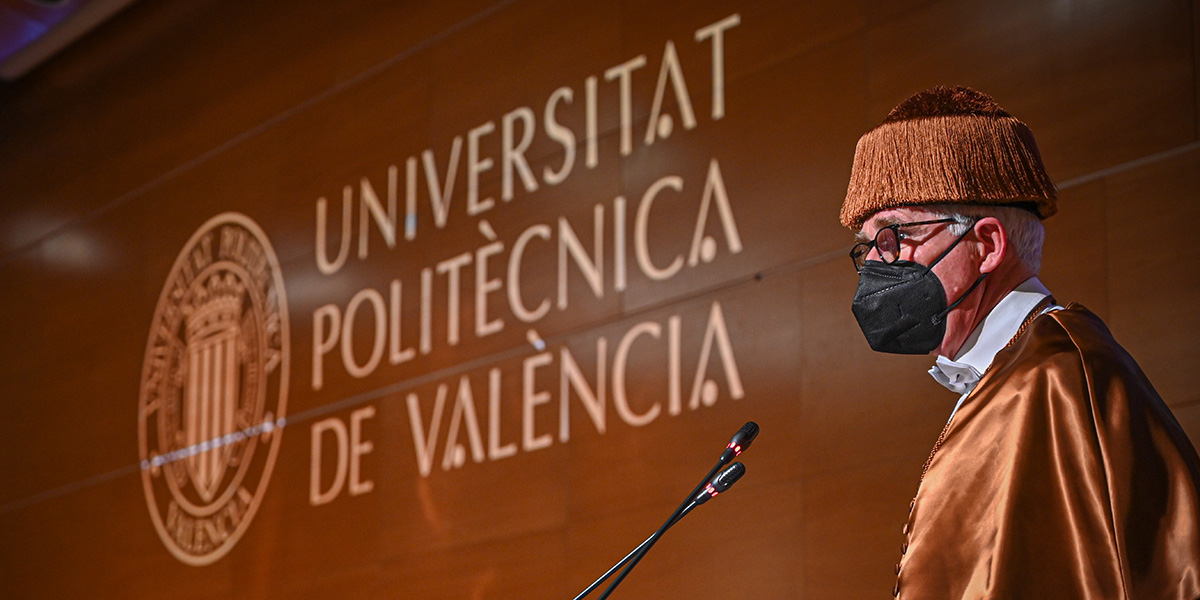
Investit el 4 de febrer del 2022, per el rector de la Universitat Politècnica de València, José E. Capilla Romá.
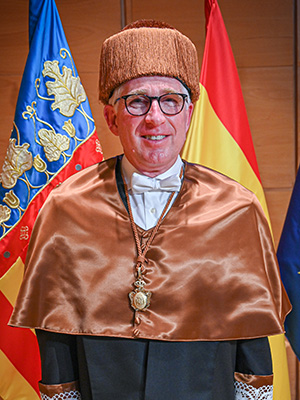
Francisco Javier Benedicto
Enginyer espanyol, destacat en telecomunicacions. Amb experiència en l'Agència Espacial Europea, va contribuir al primer programa espacial de la Unió Europea i l'AQUEIXA.
Francisco-Javier Benedicto Ruiz was born in Barcelona (Spain) in 1957 and graduated as a telecommunications engineer from the Polytechnic University of Catalonia, Barcelona (Spain).
He began developing ground equipment for satellite TV reception at Mier Allende in Spain and later joined the European Space Agency (ESA) to lead the development of fixed satellite service, TV, and next-generation mobile communications payloads in cooperation with European satellite operators such as EUTELSAT, HISPASAT, ASTRA, and INMARSAT.
Involved in satellite navigation for the past 20 years, he was a pioneer in the development of the European Geostationary Navigation Overlay Service (EGNOS) in 1994 and later initiated the development of the European Satellite Navigation System GALILEO, where he led the initial definition studies, development, and in-orbit validation phase. He currently manages the deployment of the full operational capability system, which began providing Galileo initial services in December 2016.
He is currently Head of the Galileo Programmes Department and Head of the Galileo Project Office at the European Space Research and Technology Centre (ESTEC) of ESA located in Noordwijk, The Netherlands.
He has published more than 100 technical papers and holds several international patents related to satellite engineering techniques.
The Galileo System
Galileo is the European global satellite navigation system jointly developed by the European Space Agency and the European Union. The system became operational on December 15, 2016, with 17 satellites, and currently there are 22 satellites orbiting around our planet.
This Global Navigation Satellite System (GNSS), in addition to providing autonomous radionavigation and positioning services, will be interoperable with the GPS and GLONASS systems. The user will be able to calculate their position with a receiver that uses satellites from different constellations. From practically any location on the planet, between six and eight satellites from the constellation will be visible, allowing for the determination of time and location with great precision. Interoperability with the American GPS system increases Galileo’s reliability.
The applications of Galileo will be endless; this system will be key for the development of precision agriculture and autonomous vehicles. Since 2017, hundreds of mobile devices have included chips capable of receiving Galileo signals, and already 99% of smartphones sold today are equipped with Galileo-compatible chips.
The impact of the GNSS market
According to the GNSS Market Report 2017, the global GNSS market is experiencing steady growth, reinforced by the strengthening of macroeconomic stability, increased market maturity, and the continued evolution and diversification of services.
Under this scenario, the declaration of Galileo Initial Services reflects Europe’s achievement in meeting users’ changing needs, and in enabling chipset and receiver manufacturers, as well as application developers, to begin taking advantage of higher-performance GNSS signals. Galileo-ready mobile devices have already reached the general public, including smartphones and in-vehicle navigation systems.
The initial services are the first step toward full operational capability, which will be reached once the Galileo constellation is complete in 2020. At the same time, although the number of GNSS devices in use for professional applications is much lower than that of their mass-market counterparts, the professional market is growing, and millions of people worldwide benefit from it daily—whether by enjoying the outcomes of sustainable and profitable agriculture, using efficiently coordinated transport networks, or leveraging telecommunications networks synchronized with GNSS.
Space Strategy for Europe
Adopted in 2016 by the European Commission, the Space Strategy for Europe proposes a series of actions to enable Europeans to take advantage of the benefits that space offers, create the right ecosystem for new space businesses to grow, and promote Europe’s leadership in space, with increased participation in global space markets. With Galileo and Copernicus (Earth observation satellite program) in operation, the strategy reflects a shift toward concrete applications based on space data.
In the words of Javier Benedicto, “Galileo is an innovative system by definition, born to be at the frontier of knowledge. Europe wanted to create something completely new, building on the experience of GPS, but with ten times more precision.”
Contacta con nosotros
Accede a diferentes tipos de comunicación de la UPV: consultas, solicitudes, incidencias, sugerencias, quejas, felicitaciones...