daniel gianola
Daniel Gianola
doctor honoris causa
Daniel Gianola
Investit el 8 de novembre del 2002, per el rector de la Universitat Politècnica de València, Justo Nieto Nieto.

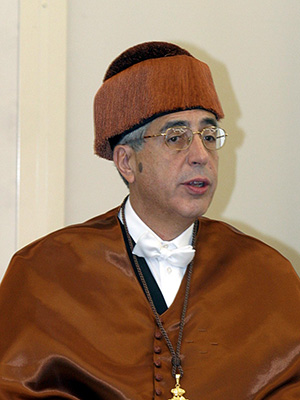
Daniel Gianola
Genetista de la Universitat de Wisconsin-Madison, és reconegut per aplicar metodologies bayesianes i no paramètriques en genètica quantitativa per a la selecció genòmica en la cria animal i agrícola, i per predir trets complexos i malalties usant models de regressió avançats.
He was born and lived in Uruguay until his graduation, and he continues to visit his country regularly, which, together with his language and character, has allowed him to connect easily with the Spanish teams who have visited him. Since 1994, he has been frequently invited by the School of Agricultural Engineering at this University. He is married with children and currently lives in the United States.
He describes himself as an animal scientist specializing in quantitative genetics.
Daniel Gianola is Professor of Animal Sciences, Biostatistics, and Animal Medical Informatics, and he heads the Department of Dairy Science at the University of Wisconsin–Madison. Together with Daniel Sorensen, Gianola pioneered the introduction of Bayesian and MCMC (Markov Chain Monte Carlo) techniques in breeding methods. He has used computer simulation techniques based on conditional probability chains, or Markov chains, in his statistical problems related to genetic improvement. His research has been published in more than a hundred articles in high-impact journals.
Productive, reproductive, and disease resistance traits in animals result from the expression of thousands of genes acting in concert, as well as environmental influences. Their analysis requires quite complex statistical techniques, especially since artificial insemination and frozen semen in dairy cattle, as well as superovulation and embryo transfer techniques, are now commonly used.
In the 1990s, the possibility of using integrators based on random Markov chains gained attention in statistical journals, and Dr. Gianola immediately studied their application in the highly parameterized models used by animal geneticists. Today, these methods have become common tools that have facilitated the spread of Bayesian statistics into the field of animal genetic improvement to generate results. In the Bayesian system, probabilities are assigned directly to the items of interest (such as the genetic values of cows) without invoking an infinite series of nonexistent experiments, and there is no need for infinitely large sample sizes. Today, physicists, economists, biologists, engineers, sociologists, and archaeologists have found in Bayesian methods the answers that classical statistics often failed to provide.
He has received many distinctions throughout his academic career.
Contacta con nosotros
Accede a diferentes tipos de comunicación de la UPV: consultas, solicitudes, incidencias, sugerencias, quejas, felicitaciones...